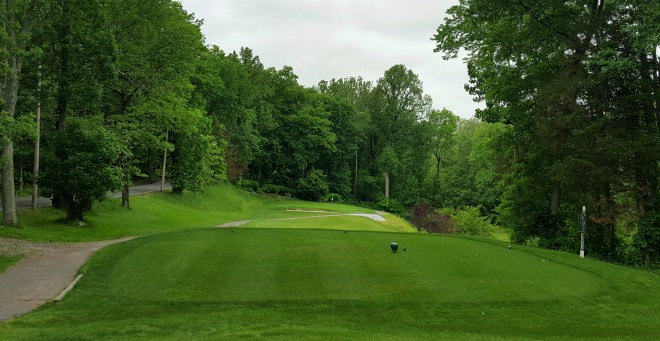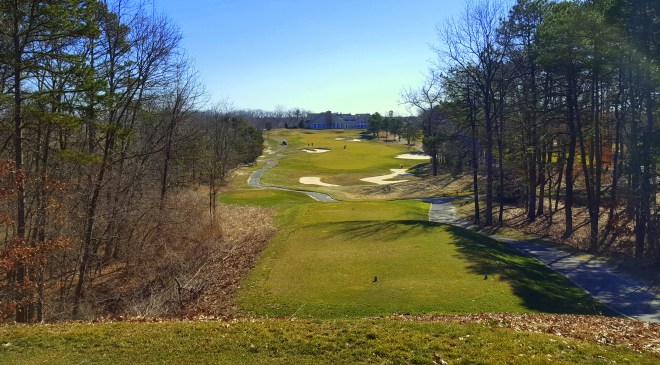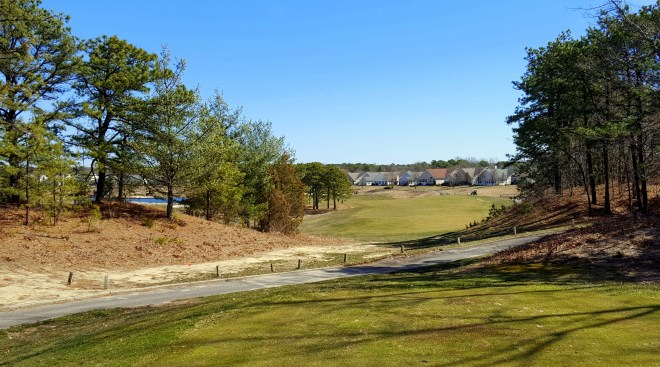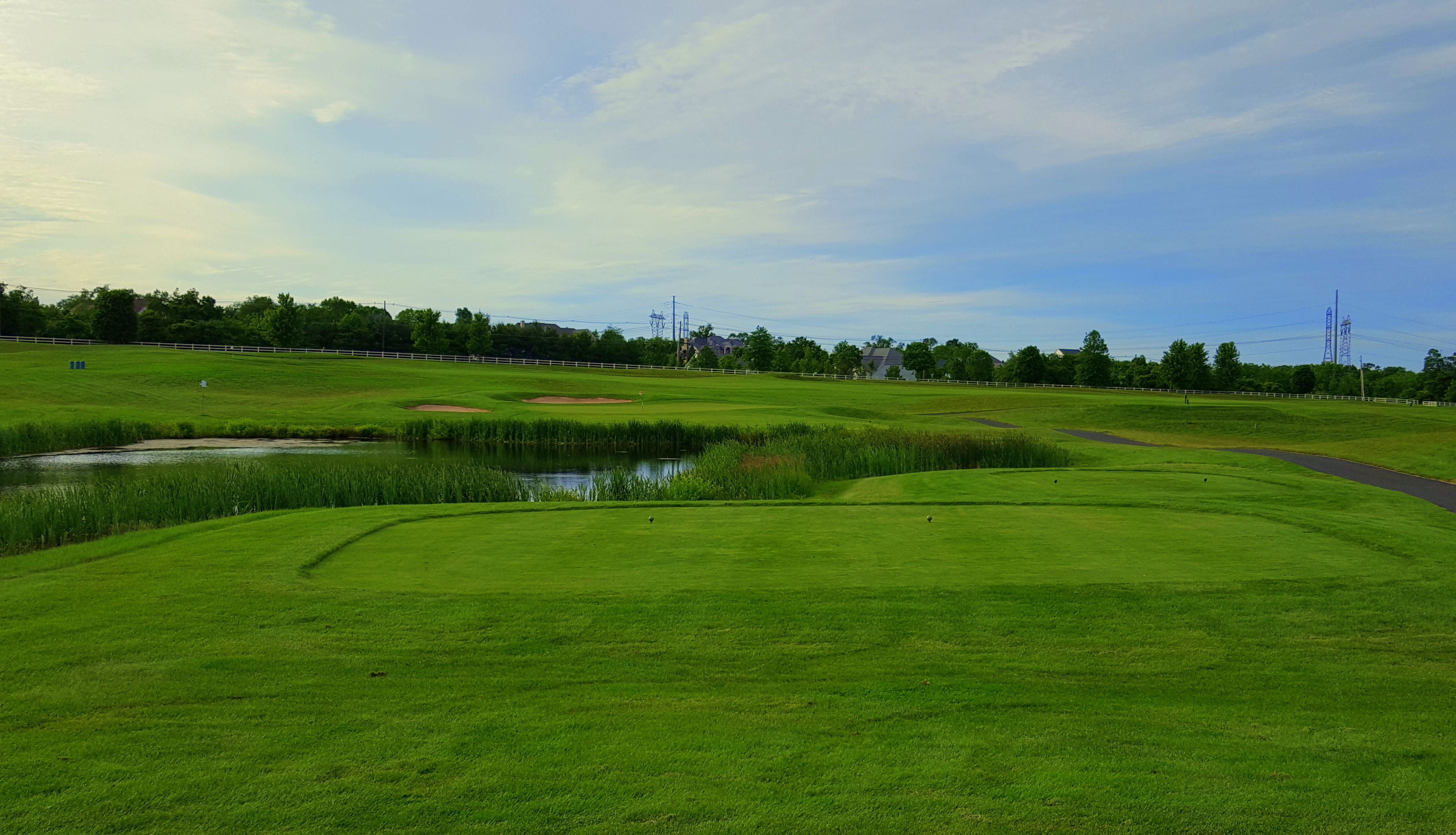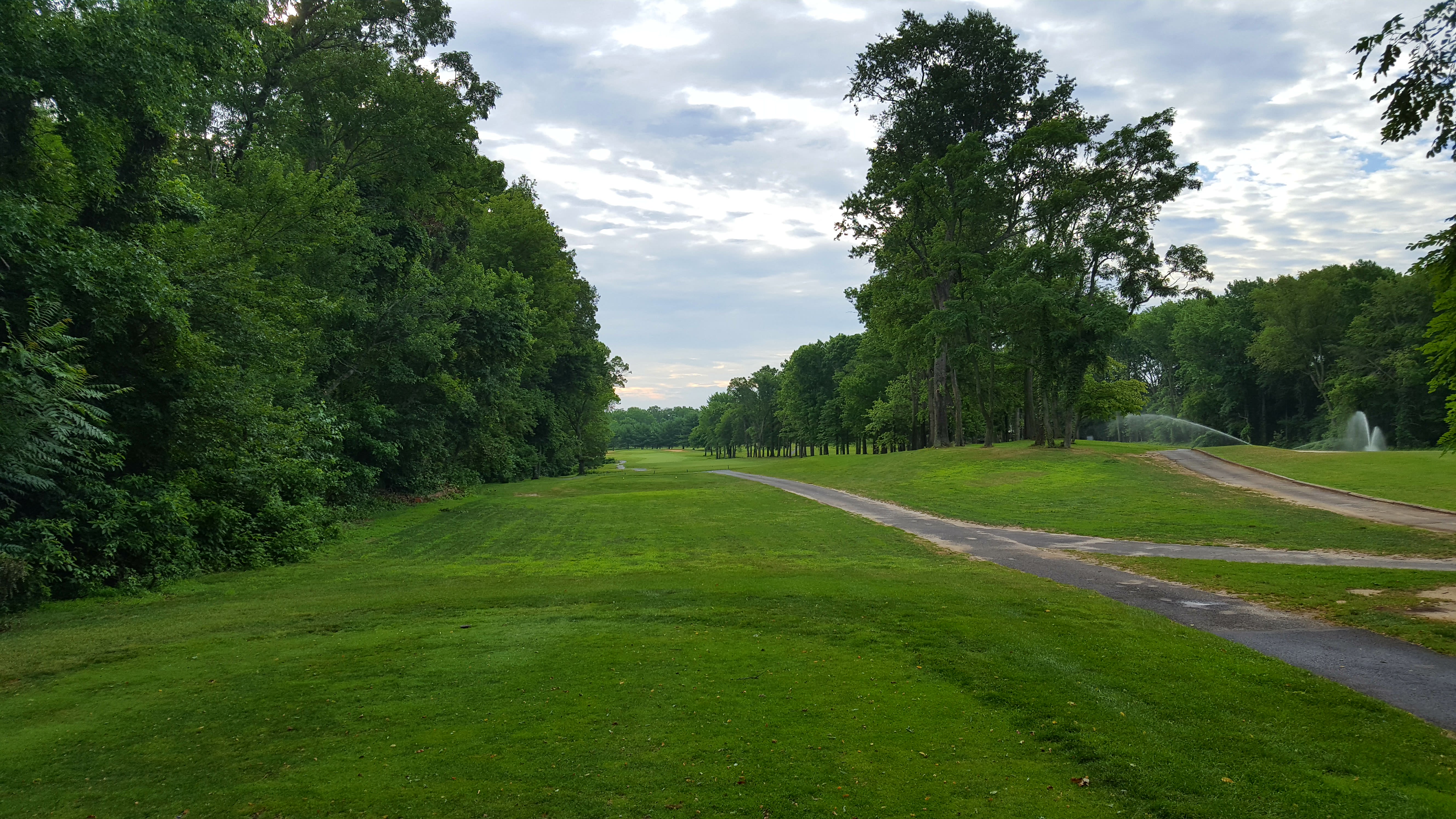
Number 79 (Weequahic Golf Course)

Date played: 9/3/2018

The 79th course on my journey has been called “a hidden gem” by Matt Ginella of the Golf Channel, and it even made his “ladder of value golf courses”. It’s hard to argue with that.

Located in Newark, NJ, and just four miles from Newark Airport, you might be able to play Weequahic Golf Course during a long layover between flights. Designed in 1913, it’s one of the older public courses in the state, but its length doesn’t match its age. It’s also one of the shortest for its par, playing as a 5,700-yard par 70 from the back tees.

You can absolutely get around this course without your driver, the only possible exception being the 16th, which plays as a 401-yard par 4. Having said that, the course can be a challenge for first-timers as it plays tightly. Its close-knit layout does make for some interesting views on the course, like being able to see the 17th and 16th greens while standing on the green at 7.

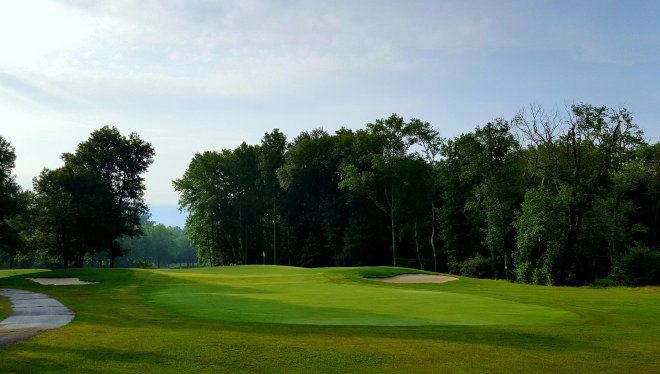
20180903_092819
On 7 green, looking out at 17 and 16 greens. A “threen” view.

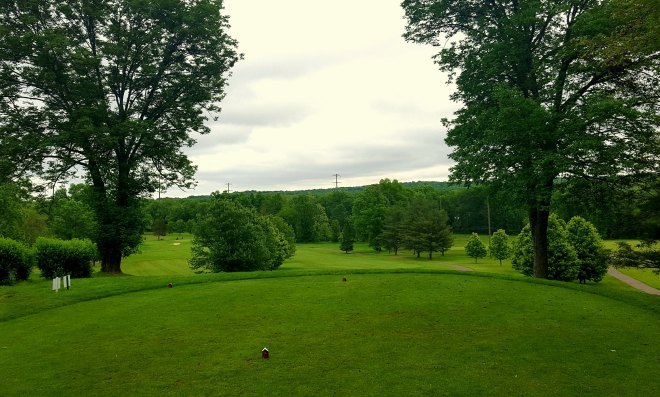
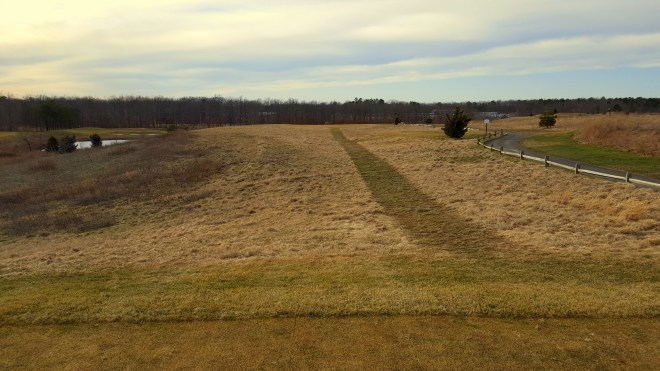
Walking might be a challenge for some, as the course rolls over a number of hills and changes in elevation, but as I’ve said before, it makes for beautiful golf. You immediately get a feel for the sinusoidal layout playing a par 4 straight uphill on 1 and then right back downhill on 2, a short par 3.

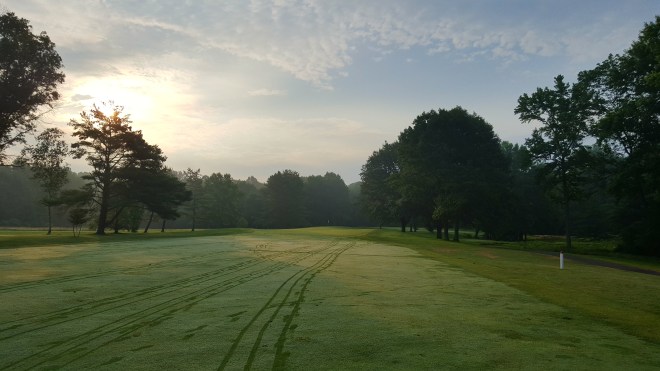
20180903_073627
Up, up, and away on the 1st tee.

As I mentioned when writing about Skyway, there is something really special about courses in a city setting. It’s very much why Central Park is so magical to so many. Were it not in the middle of Manhattan, it probably wouldn’t be as special. But it is, and so it’s adored.

The same goes for Weequahic. It’s a beautiful stretch of well-maintained grass, precisely mown to different heights in a place called “Brick City”. So, for about $50 to walk on weekends, you should absolutely check it out – before you have to catch the second leg of your connecting flight, of course.

How I played…

I should’ve left the driver in the bag. Let’s leave it at that.

Highlights: Enjoying the round with a good friend of mine. Other than that, it would be almost driving the short par-4 15th, chipping to three feet and making birdie. (Still should’ve left driver in the bag.)

Lowlights: Too many to choose from. Looking at the yardage of the course, I think my eyes went black like a Great White Shark about to enjoy a meal. I did no such thing. Play smart, people. Play smart.

Number 79 (Weequahic Golf Course)

Number 78 (Beckett Golf Club)

Date played: 8/16/2018

I’ve reached something of a somber moment in my journey in writing this post about my time at Beckett Golf Club. While there will be more stories like it to come, this marks the first time that I get to talk about a course that has since permanently closed.

Located in Woolwich Township in southwestern New Jersey, Beckett was the first Gloucester County course I played. Built in 1977, it was originally a 27-hole layout with Red, White, and Blue nines. What remained when I played was an 18-hole course straddling Kings Highway, and an actual 19th hole – a vestigial remnant of the abandoned nine.

20180816_181516
You actually needed to play the 19th to get back to the clubhouse.

While there were plenty of signs of the course being neglected and possibly headed for closure – bare tee boxes, some burnt out greens, and areas of poor drainage – I want to focus on the positives and imagine the course in its heyday.

With fairways cut in a centerline mow pattern and lined mostly with beautiful evergreen trees, Beckett was a classic parkland course. A majority of holes played over level terrain, but there were a number that had some character.

20180816_162240
In position for a good approach into 8.

The 8th was a short par 4 where your approach played over a valley of overgrowth. The 15th was a long par 3 that could be visually intimidating, with a large deciduous tree overhanging and possibly blocking potential tee shot trajectories. The landing area for your tee shot on the par-5 16th was blind, just over the top of a hill. Pepper in some dog-legs, some interestingly sloped greens, and there was decent variety for this 6,025-yard course.

20180816_165111
A bench at 15 tee offered a seat upon which to contemplate navigating that massive tree.

It’s disheartening for me to think about any course shuttering for good, but the truth is this course was nowhere near halcyon days when I played it. Demand was almost certainly non-existent. I imagine some may even be muttering “good riddance” at the thought of its passing. I only wish I could have seen it in better times.

20180816_181749
The sun sets on Beckett Golf Club.

Though the 18-hole course at Beckett joins the already defunct nine, my journey continues. I look forward to seeing what the remaining public courses in Gloucester County have in store.

Number 78 (Beckett Golf Club)

Number 77 (Howell Park Golf Course)

20180704_071042 - Copy

Date played: 7/4/2018

Howell Park Golf Course became the sixth track I’ve played in Monmouth County when a Twitter golf buddy (shout out to @njcroatian) invited me out for a round on Independence Day. Located just east of the Manasquan Reservoir, the course is wonderfully maintained and is part of the Monmouth County system, which at this point in my journey is arguably the best in the state in terms of access for quality.

20180704_064756
Quality dew tracks on the 1st

A parkland-style course that is known for keeping its rough up a bit, Howell Park rewards smart play that consists mostly of keeping the ball in front of you. The greens are some of the largest in public golf in New Jersey, averaging 34 paces in depth and some wider than they are deep. If you give yourself shots at the green and you putt well, this should be a course where you can score.

20180704_073108 - Copy
The green at the par-3 4th

The only complaint from an architectural standpoint is that Howell Park sits on a very level tract of land, so it lacks the views that come with elevation. However, its flat nature also means that it is a very walkable course. At $62 to walk on weekends for non-residents/non-cardholders, there is certainly cheaper public golf in the state. Regardless, I consider it a top-notch course and absolutely worth a round (or three).

20180704_104056

How I played…

Hot and cold: Somehow, with penalty strokes on four different holes, I almost played down to my handicap.

Highlights: The singular highlight is easily the 18th. After watching my playing partner drain a 65-foot par save from the fringe, I followed up with a very lucky 54-footer for birdie. I think it rerouted twice on its way to the hole.

Lowlights: Penalty strokes; especially a ridiculous attempt on the 10th to “cut” one into the dog-leg that ended up OB on the driving range.

Number 77 (Howell Park Golf Course)

Number 76 (Knoll Golf Club – East)

Date played: 5/28/2018

When a golf course uses the ‘CC’ abbreviation in its name, it’s clear that’s short for “Country Club”. When “GC” is used, there can be slight uncertainty as to whether it’s “Golf Course” or “Golf Club”. The 76th course on my journey seems to have a more complex issue with its name.

According to the website (knollgolfclub.com) the facility is named “Knoll Golf Club”, and there is an East Course and a West Course. That is of course, until you click on the East Course info link. Then, it’s “Knoll East Course”… but also “Knoll East Golf Club” approximately two words later. When you pull up to the clubhouse, the sign reads “Knoll Country Club East”. When you get your scorecard, it says “Knoll CC – East Course”. Others may call it “Knoll East Golf Course”, or simply “Knoll East”.

Now that we have that settled…

Knoll East – which is what I’m gonna go with for brevity’s sake – is the public half of the Knoll facility. Located in Parsippany – Troy Hills, the course is a shorter one, tipping out at just over 5,800 yards. What it lacks in distance though, it makes up for in personality.

20180528_075324
Bombs away on the 1st!

The clubhouse is the highest point on the property, which makes for great elevated tee shots on both the 1st and 10th holes. That also means challenging approaches on the 9th as well as the 18th, where the back-to-front sloped green can end a round on a three-putt low note.

The 5th is a demanding par 5 that requires playing to a distance off the tee and then navigating a chute on the approach shot(s). There are a couple fun short par-4s in the 7th and 11th, and the 12th is a straight-forward par 3 that might instill some doubt with thoughts like “don’t be left OR right”.

20180528_103328
The 12th is a scoring hole. Just don’t be left. Or right.

Whatever you decide to call it, Knoll East is nice stop for public golf in Morris County.

How I played…

While there were some birds in a nest on the exterior wall of the pro shop, unfortunately, there were no birdies on the card. That didn’t stop a good time though.

Highlights: Played +3 on an eight-hole stretch from 7 to 14.

Lowlights: You know that three-putt low note on 18 I mentioned? I write from experience. Also, the 5th hole ate me alive.

Number 76 (Knoll Golf Club – East)

Numbers 73, 74, and 75 (Eagle Ridge Golf Club – Ridge, Pines, and Links)

From this vantage point, you are standing on the Links, looking across the Pines, eventually out to the Ridge in the distance

Date played: 3/17/2018

My journey took me to Eagle Ridge Golf Club after one of my best friends invited me to a golf outing. Located in Lakewood, Ocean County, Eagle Ridge is a facility with three distinct nines, named (or at least supposed to be) for their differentiating topographic and architectural features: Ridge, Pines, and Links. Interestingly, while the holes are numbered from 1 to 27 – Ridge 1-9, Pines 10-18, then Links 19-27 – the nines are all handicapped as individual nines. As I mentioned about my time at Flanders Valley, to me, this is a defining characteristic of considering the course as separate nines, as opposed to an 18-hole course and a 9-hole course (or in the case of Flanders, four 9-hole courses as opposed to two 18-hole courses).

The Shamrock Shootout (still the best name for any sporting event on St. Patrick’s Day) was set to be a 2-man scramble with Stableford scoring on the Ridge and Pines nines. If that would hold true, I don’t think I could’ve counted them as complete on my quest. Scrambles are fun, but playing them is not the same as playing your own ball, where you get a sense of the challenge of a course and its setup. Thankfully, we would be playing with some golf buddies of my friend, who were more than amenable to having us all play our own ball and enjoying the round.

The 18th at Eagle Ridge, coming out of the Pines

Pines (73)

The scramble began at 9:00 am with a shotgun start, which meant our round started on the par-3 16th of the Pines nine. Playing a course out of order is always an appealing change in principle – like my time at Beaver Brook – but it definitely leaves you wondering what the experience would be like on the normal routing.

The Pines is named for the trees that line most of the nine, though there are areas that open up, such as the 18th fairway, and an attractive set of approaches for the 12th and 14th greens around a pond. There is a good mix of both tight and wide landing areas, and you will need accuracy to score well here.

The 5th is a dog-leg left par 5, playing to the bottom of the Ridge

Ridge (74)

The Ridge nine plays as something of a ridge-and-basin layout. The “ridge” would be the outskirts of the Pines along the long par-5 7th and the bottom of the “basin” would be the body of water along the green of the par-5 5th. However, the slope across holes is gradual, making it more of a “side-of-a-hill” layout.

In general, the Ridge plays far more open than the Pines and is therefore much more forgiving. I’ve mentioned before that it’s difficult for me not to enjoy or appreciate a layout when I’ve played well, and I played some of my best golf on the Ridge nine. I think of it as something of an ideal course. There is beauty in its elevation changes, there is character in its greens, and it’s almost impossible to be penalized by a good shot.

Welcome to the 19th

Links (75)

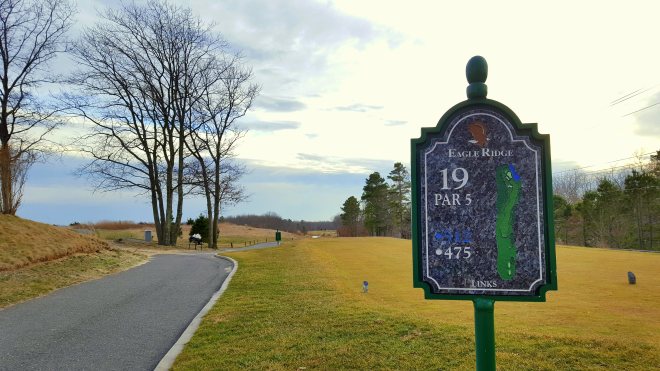
THERE’S AN ACTUAL 19TH HOLE! As I mentioned earlier, the Links nine are actually marked both on the card and the course as holes 19 through 27. I also alluded to the fact that, while Ridge and Pines are appropriate descriptions for those nines, I don’t think “Links” accurately describes its nine holes. There isn’t much on offer at the Links that you don’t see at the Ridge. The Links nine are spread out over a much larger plot of land, so you do have vast grown-out areas between some holes, but there isn’t anything that really offers a “links” feel.

By far the most interesting hole on the Links is the 25th. A short par 4, the landing area for the tee shot is blind, requiring a stone at the end of a plateau as a target. The fairway is generous, so most tee shots will land safely, but the approach is 90 degrees left, almost entirely over water.

The 25th green is on the left in the distance, but you’ll need to aim over the stone at the end of that walking path

Eagle Ridge as a whole…

Apart from the two-out-of-three-ain’t-bad naming for its nine-hole courses, I rank Eagle Ridge highly among the public courses I’ve played so far. The course’s condition is more than worth the in-season rate of $86. Also, I’m not sure it applies all season, but I was able to get a great replay rate of $25 for playing the extra nine, which would be a great touch for a great course.

How I played…

Pines-Ridge wrap-around: Poorly on the pines, remarkably on the Ridge. The highlight would definitely be the lack of a three-putt hole.

Links: Meh. Pressed for time, I was in a bit of a rush to get done and get home, but that’s no real excuse. I played mediocre golf.

Numbers 73, 74, and 75 (Eagle Ridge Golf Club – Ridge, Pines, and Links)

Number 72 (Old Orchard Country Club)

20180221_080524 - Copy

Date played: 2/21/2018

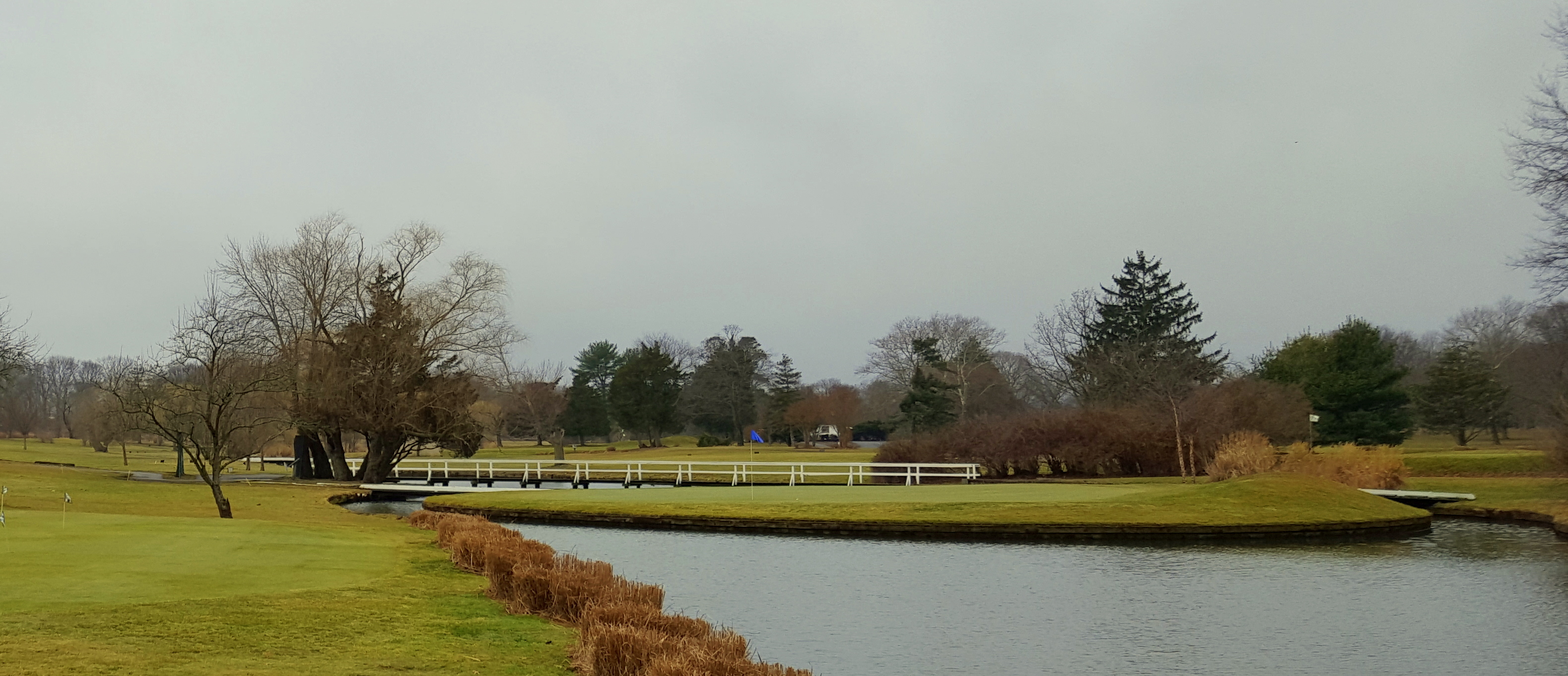
A Tillinghast design brought to life in 1929, Old Orchard Country Club takes its name from the apple orchard it was built on. Located in Monmouth County, the course prides itself on a sense of family and community. While there weren’t many golfers on the course on a cold February day, that’s certainly the feeling I got when listening to conversations at the pro shop.

The front and back nines of the course are split in two by Turtle Mill Brook, which widens to surround the island green of the signature par-5 7th hole. The overall layout can be thought of as a butterfly, with the body running along the brook through the 9th fairway, and each nine as its two wings.

The routing traces the outer edges of the wings and then back inward. The front nine takes you around the southern perimeter of the course and back to the clubhouse along the brook. The back nine then runs around the northern edge and back inward again, but not before making an interesting stop at 13.

Old Orchard 13 - scorecard
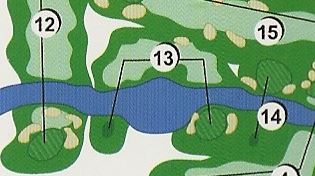
Scorecard artist’s rendition of 13…

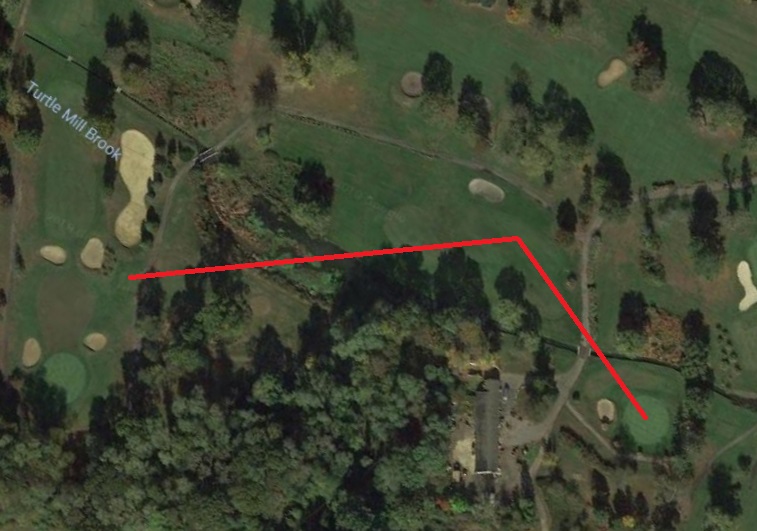
On the scorecard layout depiction, even though it’s a par 4, the 13th hole looks as if it plays in three shots like a C-clamp. I’m not sure if tee boxes have been moved since that layout was drawn, but in reality, it’s a relatively easy (14th handicapped) two-shot hole where you can play a mid or long iron off the tee and be left with a scoring club into the green if you find the fairway. The brave can even try to carry the trees right and go for the green off the tee, something one of my playing partners for the day did with decent success.

Old Orchard 13 - rotated
… 13th hole in reality.

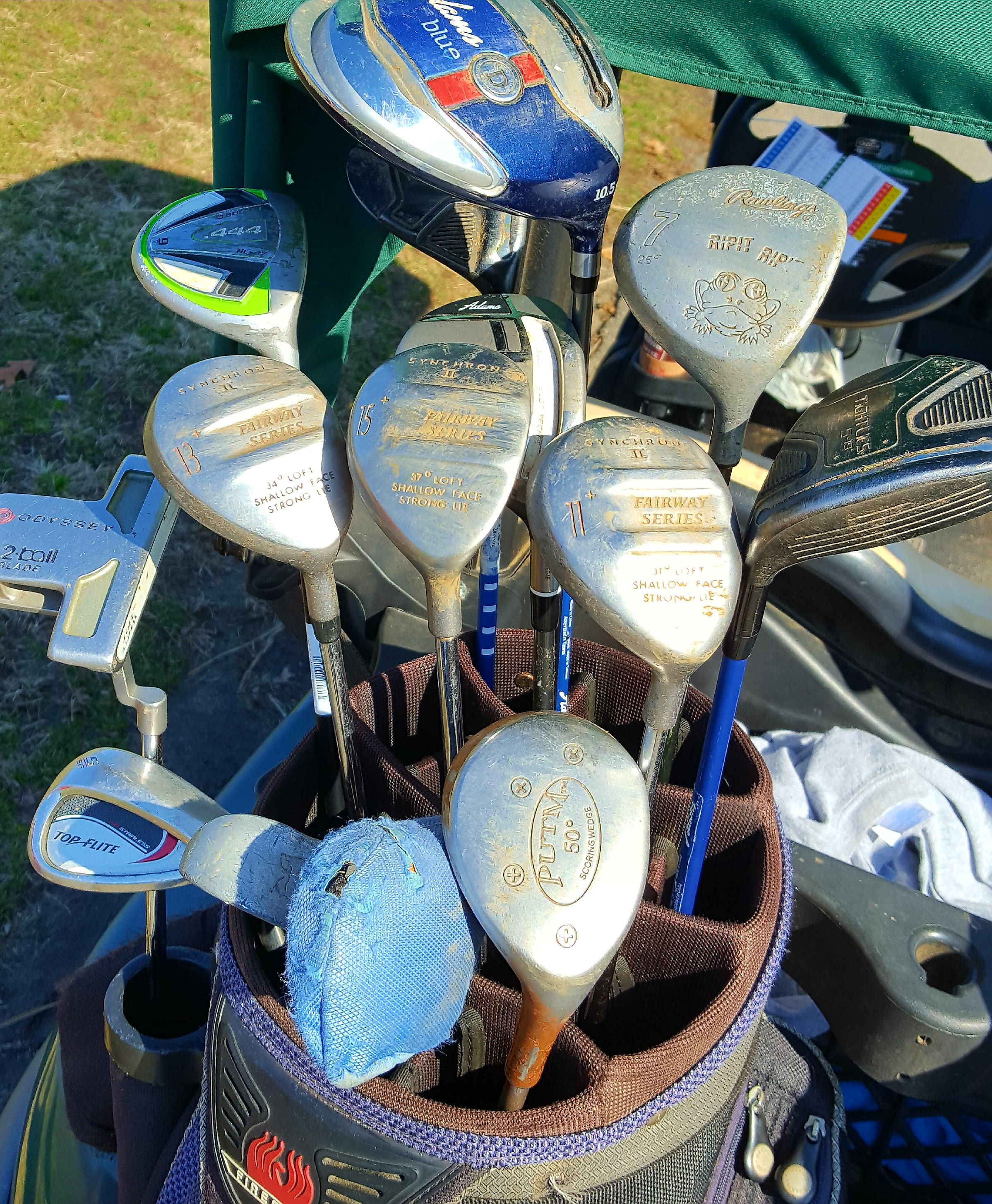
As I’ve mentioned before, part of the fun of this journey is meeting other golfers around the state. At Old Orchard, I joined a threesome of regulars who were great company, one of whom had what was easily the most interesting bag of clubs I had ever seen. There were nine fairway woods! That included an 11w, 13w, 15w, and a 50-degree “scoring wedge” (but definitely a wood).

20180221_152516
Best. Bag. Ever.

The story goes that he had a bad bout of the shanks during a golf trip down in Myrtle Beach. He noticed the fairway woods for sale in the pro shop, and the rest is history. Well, at least local golf history among Old Orchard regulars, and in the playing of the 72nd public course on my quest.

How I played…

Pretty ******* terribly. It had been my first round in a month, and while I hit eight fairways, I really didn’t do anything else well. Having hit four GIR, I was 0 for 14 scrambling. Other than good company, it was a round to forget.

Number 72 (Old Orchard Country Club)

Number 71 (Ash Brook Pitch & Putt)

Date played: 12/21/2017

Arriving at Ash Brook at 2:40 pm on the winter solstice, daylight was at a premium. Lucky for me, I was only looking to play the pitch-n-putt course to wrap up my three-course day.

Pitch-n-putt golf will always hold a special place in my heart because it’s how I learned to play the game with a group of high school friends. I discovered the Ash Brook pitch-n-putt when I played the regulation course in 2015. It seemed like a sequestered practice area, and I didn’t give it much thought beyond that, but this was also about six months prior to realizing that I would want to play every bit of public golf in New Jersey.

A nine-hole course spanning 673 yards, there is no hole over 100 yards. Depending on a golfer’s ability, there may be a couple holes where you’re taking a full wedge shot – like the uphill, 92-yard 1st – but most holes will be “feel” shots from the tee box.

20171221_151508 - Copy
A look at the 2nd hole. Even though you’ll tee off from mats, you will appreciate the quality of the maintenance on this short course.

Which brings me to the one point of disapproval most golfers will have with the pitch-n-putt course; it plays off mats (the horror!). Personally, I don’t mind. It certainly isn’t good practice for ball striking, but the pitch-n-putt isn’t about that. This is really a place for beginners and younger players to learn the game. And with that in mind, I have yet to play at a better place than the Ash Brook pitch-n-putt.

Beyond the mats for tee boxes, the course is in immaculate shape. The greens are expertly manicured, with clear distinction to the fringe and again to the rough. The rough around some of the holes will be a true test, especially for someone learning to play the game. There is a mix of level holes and a few with elevation changes. It is remarkable what they squeezed into this plot of 700 yards. Again, you would be hard-pressed to find a better pitch-n-putt facility. All of this for a twilight rate of $7 on a December afternoon.

20171221_153817 - Copy
Beginners will learn to hone their tee-shot accuracy as the well-grown rough is a deterrent.

There are some who might argue that this shouldn’t count as a course on my journey. Whether it’s the mats, or the overall lack of yardage and minimal club choices, there are reasons “this isn’t real golf”. That may be true. For me, it’s somewhere the game – or at least some semblance of it – can be played, and it’s open to the public. And for that, it will be counted as Number 71.

Number 71 (Ash Brook Pitch & Putt)

Numbers 59, 60, and 61 (Ramblewood Country Club – Red, White, and Blue)

20170701_072914

Date played: 7/1/2017

If Ramblewood Country Club has any claim to fame in the list of public courses in New Jersey, it’s that it’s one of Ron Jaworski’s properties. Jaworski owns seven golf properties in all, and Ramblewood is the newest of his properties, purchased in 2016. It would be my first of the five in NJ.

Ramblewood CC is a 27-hole layout, split into the Red, White, and Blue nines. It was a bit of a drive for me, so I always had it in the back of my mind to play all three nines in one trip. Making a Saturday morning tee time though, I was conscious of not leaving my wife burdened with the kids for too long. To give myself the best shot at a quick round, I booked a 6:00 am tee time.

White (Number 59)

Meeting a Twitter golf buddy for the round, we were able to get squared away with the starter and sent out immediately. I was able to hit the fairway on the first, but bladed my approach slightly to put me over the green. After chipping on through a tree, I three-putt from 31 feet for double-bogey. I made five straight bogeys from the 2nd to the 6th, before finally making par on all three holes into the turn to finish +7.

The White nine is generally unremarkable. It is mostly level, with some rolling features. All three nines of the property are set inside a community, so there are house-lined holes and a few tree-lined fairways. Apart from its average routing and features, it is a well-maintained golf course. Greens are kept in great shape, and they roll slightly faster than the average public course in NJ.

Blue (Number 60)

After finishing the White nine, we knew we were making good time, so we jumped onto the Blue immediately. I continued the par streak on the par-3 1st and par-4 2nd. On the par-5 3rd, I lost a ball in a lateral hazard after my 3-wood flailed out to the right, and was only able to make double-bogey after the drop. After bogeying the 4th, I hit four of five fairways from the 5th to home. However, poor ball striking meant I only carded par on 7 and 9. Bogeys on the rest of the holes meant I would finish the Blue in +6.

Coming off the 9th, the starter was swarmed with groups, everyone waiting to get out – night and day from the start of our morning. We looked down at the time, and it was only 8:35. There have been a number of superlatives on my journey so far, but 2 hours 35 minutes is far and away the fastest I’ve finished 18 holes of golf.

The Blue made for more interesting play than the White as it is much tighter, particularly on the 3rd, 4th, and 8th holes, and it’s in equally good condition.

Red (Number 61)

Amidst all the groups looking to get out, full credit goes to the starter who was able to get us on the 1st tee of the Red nine in just 30 minutes. Perhaps excited that I was going to be able to complete all three nines, I completely botched the first. A weak and lazy drive meant I would slice it into the lateral hazard. A drop and a couple attempts to get onto the green resulted in triple-bogey.

That pretty much set the tone for the rest of the nine, over the course of which I played mediocre golf at best. There wasn’t anything particularly challenging about the Red nine, but I couldn’t put anything together. The highlight was certainly my approach on the 8th, a relatively long par 4. After pulling my drive left, I had 184 yards uphill to the green. I also needed to draw around some overhanging branches, and it came off just right. With a bit of draw, I was able to avoid the bunker on the right, and land just off the green. I chipped my third shot to 3 feet.

The lowlight was missing the 3-footer for par.

I was able to par the 9th to close, which was nice. But, with the 2nd being the only other par on my card for the Red, I would finish +9. Starting at 9:05 and wrapping up at 11:11, the Red nine took nearly as long as the first 18 we played.

The Red nine is much like the White, and perhaps even a bit more open. Again, the overall condition was great. Being the weekend before Independence Day, all pins flew American flags, which – according to my playing partner – is something Jaworski does at all his courses around the holiday. My only complaint was the “replay rate” we got for the Red nine. The fees for the pre-booked White-Blue combination was $69 ($34.50 for each nine), but we paid $37 for the Red. Not the end of the world – and both rates included the cart – but I would expect a rate that would beat an online booking through the course website.

Overall, however, the price of golf at Ramblewood is commensurate with its quality relative to other public golf in NJ – just a touch above average. I look forward to playing the other Jaworski-owned properties.
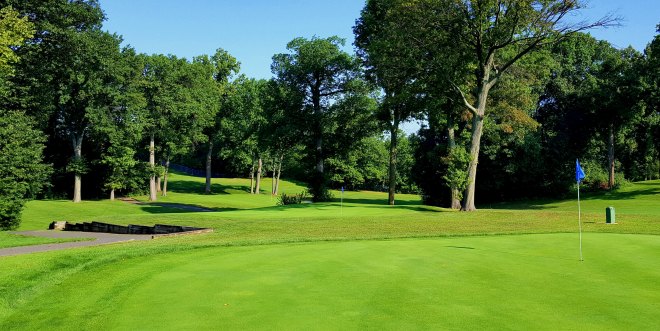
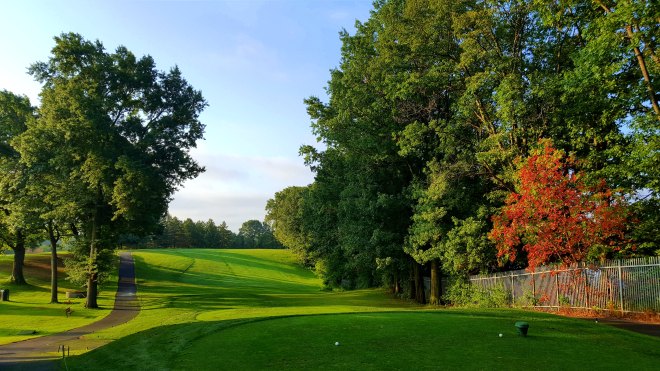
Numbers 59, 60, and 61 (Ramblewood Country Club – Red, White, and Blue)

Number 57 (Neshanic Valley – Academy Course)

20170608_183646 - Copy

Date played: 6/8/2017

The Academy Course at Neshanic Valley is something of an unusual bird to me. As its name implies, it’s meant to be a learning facility, apart from the Meadow, Lake, and Ridge nines that offer championship golf. It plays at par 32 through its nine holes, with only par 3’s and 4’s on the card. From the longest tees, it’s just over 2,000 yards. Other than Galloping Hill’s Learning Center 9 – which I have not yet played at the time of writing – I haven’t seen or heard of any other courses like it.

In keeping with the spirit of the spontaneity of my 56th course, I also happened to make the Academy course the 57th on a whim. I was wrapping up my day at work, realized I would have time on that late-spring evening, and decided I would drive out there immediately after I had “clocked out”. It was the continuation of a great week for me, as I had just seen Iron Maiden in concert for the first time at the Prudential Center the night before.

Unlike my round at Town & Country Golf Links, where I was just hoping for decent golf and ended up playing some of my best golf, at the Academy Course I was hoping for some of my best golf… but only ended up playing decently. It was slightly breezy, but nothing unmanageable. I played poorly off the tee, only hitting one of five fairways and none of the par-3 greens. Still, I managed to make par on the 5th, 8th, and 9th and finished +7.

As with the championship layouts, the Academy Course is in impeccable condition. I have recently taken to walking courses more often; partly for cheaper greens fees and partly because I haven’t really been getting any other exercise. As short as the course is, I would strongly suggest walking it. From most of the Academy course, you have great views of some of the Meadow nine, and the course itself is beautiful. The walk down the hill on the 9th was particularly picturesque, with the sun setting in the distance to the left. Other notable features are the 2nd, which is a 166-yard par 3 that plays slightly over water, and the 8th which – at the back tees and depending on your strategy – has a tee shot that may need to be played through a window of natural overgrowth.

20170608_184928 - Copy
The par-3 2nd… what water?

Overall, the Academy Course holds its own in adding value to the experience of golf that is on offer at Neshanic Valley. Yet another reason it remains, for the time being, my favorite public course in New Jersey.

Number 57 (Neshanic Valley – Academy Course)

A man named Kermit

On October 15, 2015, I was enjoying a round of golf at Hyatt Hills Golf Complex (Clark, NJ) with a friend from work. As we walked to our second shots on the par-4 15th – which is the 6th on this 9-hole course – the pair behind us hit their tee shots. Typically, you’d expect players to wait until we’ve hit our second and we’re on our way to the green, but they were apparently in a hurry. They walked up and asked if they could join. We obliged.

The pair introduced themselves as Andrew and Kermit. Over the course of the closing four holes, we would learn that they work in Manhattan, and they were actually getting a round in before heading to work later that afternoon. I was immediately jealous. In addition to normal golf pleasantries, Kermit shared something that would set me on a journey.

“My wife and I figured out that there are 148 public courses in New Jersey,” he said, “and our goal is to play them all. No timeline.” Right then, I knew I too had a new goal in life. I had always enjoyed playing courses for the first time, but the prospect of playing over 100 of them was overwhelmingly exciting. Where should I start? How would I find all these courses?

This blog will chronicle my journey to play all public courses in New Jersey. It will also serve as a log of how I develop as a golfer. I can tell you that there will be plenty of statistics, the occasional strong opinion, and hopefully, some engaging stories.

I may even run into a man named Kermit again.

A man named Kermit