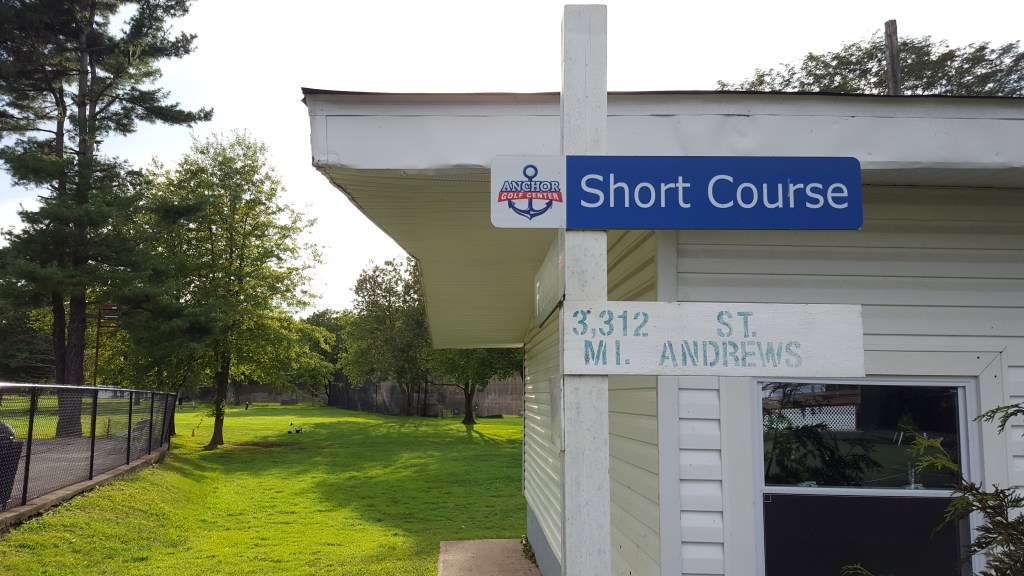
Date played: 8/23/2019
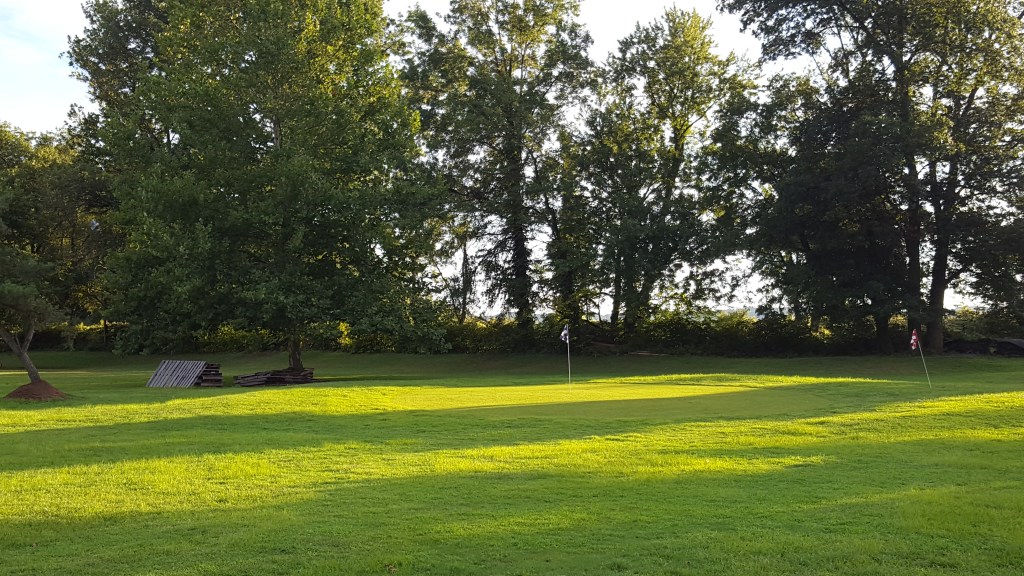
If I had to guess, I’d say the 90th public course I played in NJ is one whose legitimacy in my list is questionable to many. It’s something between a pitch-n-putt course and a par-3 course. There are mats for tee boxes, it “tips out” at under 800 yards, and the greens are a mix of clover and other weed growth. You could probably install cups and flagsticks in your backyard, set the lawnmower to the lowest mow height possible, and you’d get similar results.
Having said that, I count the Par 3 course at Anchor Golf Center on Route 10 in Whippany for three simple reasons.
- It’s a place to play at least nine holes of golf
- It has a scorecard with yardages for each hole
- It’s completely open to the public as a daily fee course
Apart from the greens, there are a couple other items of note about the course. Following an extended period of rain, the course was soggy, especially at the back of the driving range on holes 5 and 6. There were also a couple tee shots (on holes 4 and 7) that were at least partially obstructed by trees, which may trouble the beginner but add an element of challenge for an experienced player.
At the time of writing – November 2020 in the midst of the COVID-19 pandemic – the Anchor Golf Center website says that the Par 3 course is “closed until further notice”. It’s unclear if that means closed for the winter season or closed for good, but it would be a shame to lose a place like this.
In my opinion, these short courses – suboptimal conditions and all – deserve a place in the golfing world. They’re places to learn the game. The easiest way to make the transition from driving range to regulation course is by using these short courses as an intermediate step.
While I’m counting them all, and my criteria may seem loose to some, I’m curious what you think. Would you count a place like this on a list of public courses? If not, how would you define your criteria for such a list?
 Orson Rosas Golf