At 2,616 yards for its nine holes, Colonial Terrace was a short stop on the journey. Dedicated to William F. Larkin – long-time mayor of Ocean, NJ where the course is located – the course plays to a par of 35, which includes two par-5 holes.
The 4th and 7th holes are 415 and 430 yards respectively. If you’re still searching for your first eagle, this may be the place to do it.
The par-5 4th and 7th holes
Or is it?
The USGA states that in order for a hole to be considered a par-5, it must have a minimum yardage of 450 yards for men, and 370 yards for women. Which raises an interesting quandary: if you hole out in three shots on one of these holes, are you counting it as an eagle?
I say ‘yes’. To me, you can only play what’s presented to you. If the scorecard says it’s a par 5, then it’s a par 5.
The opening hole
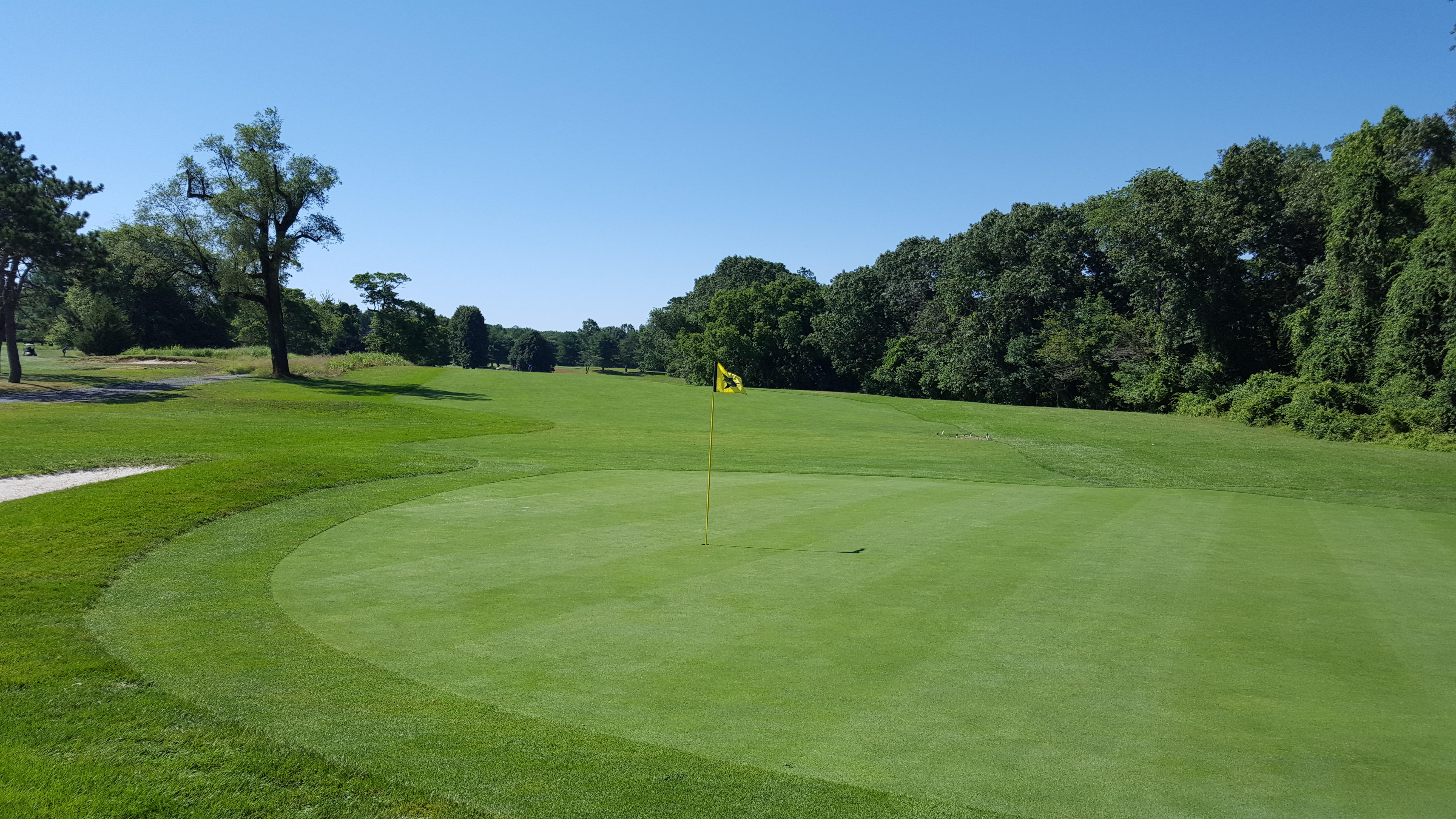
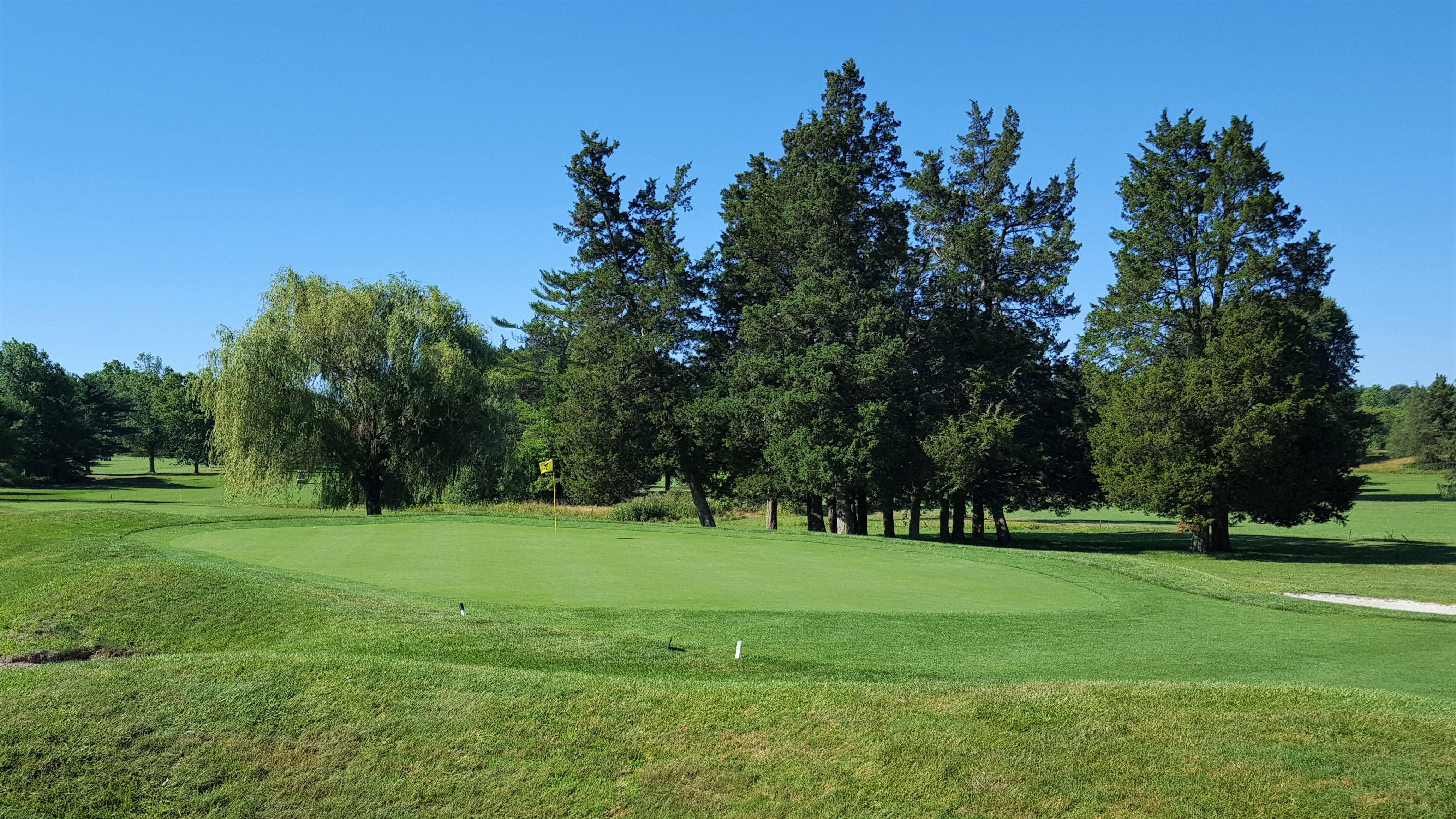
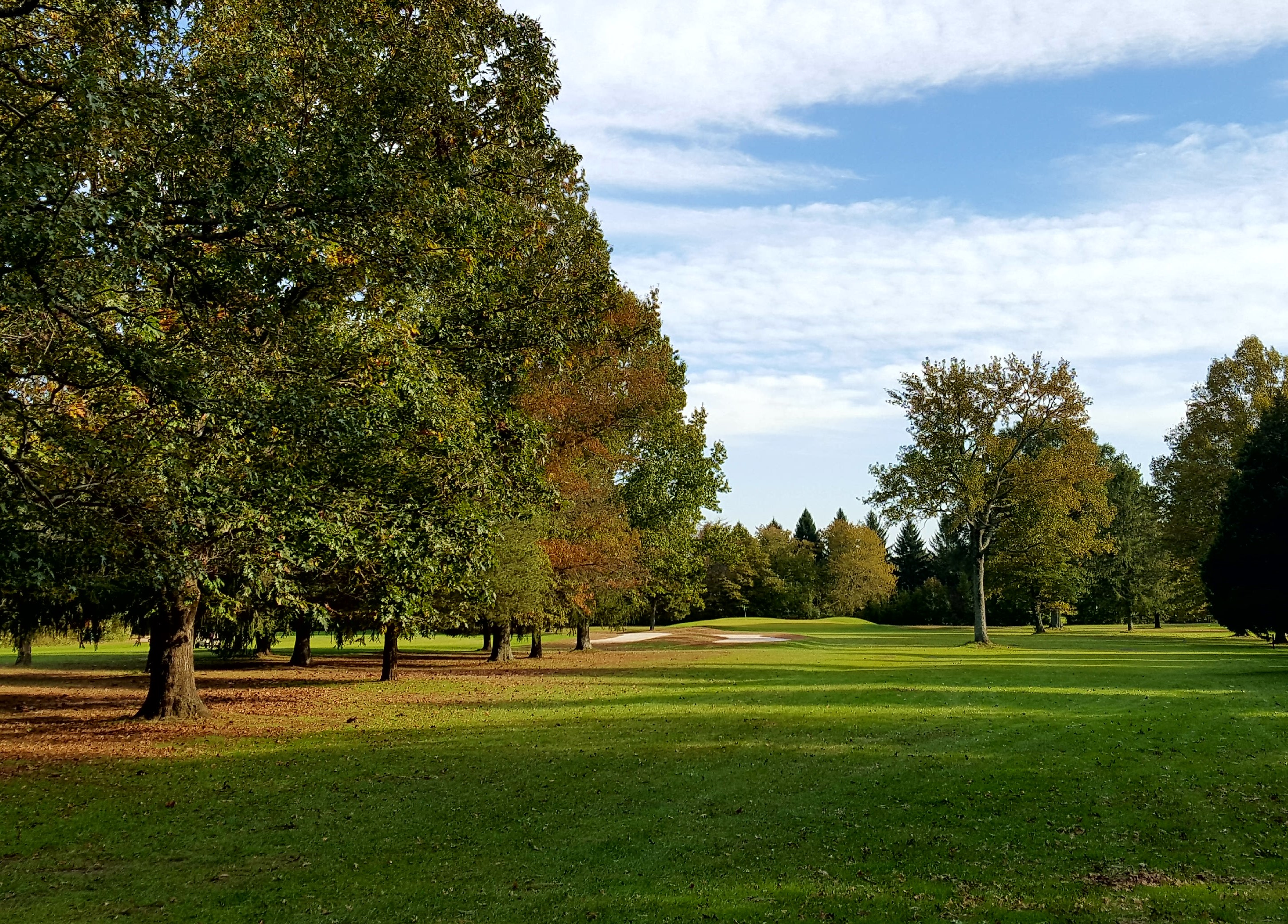
The layout is entirely flat and plays generally open, where even the holes around the perimeter have some room to bail out towards the center of the course. The greens are small and will test your approach play.
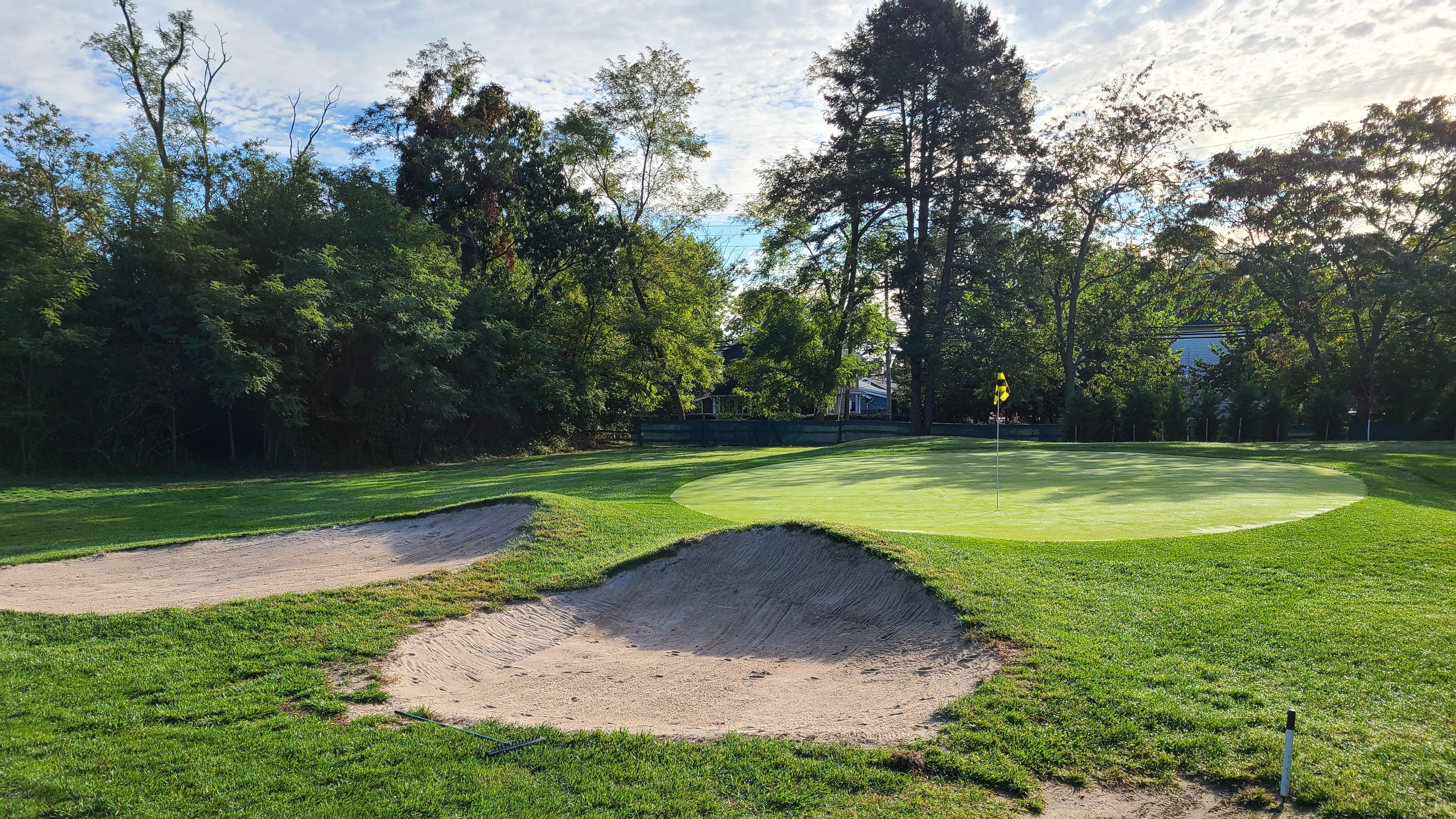
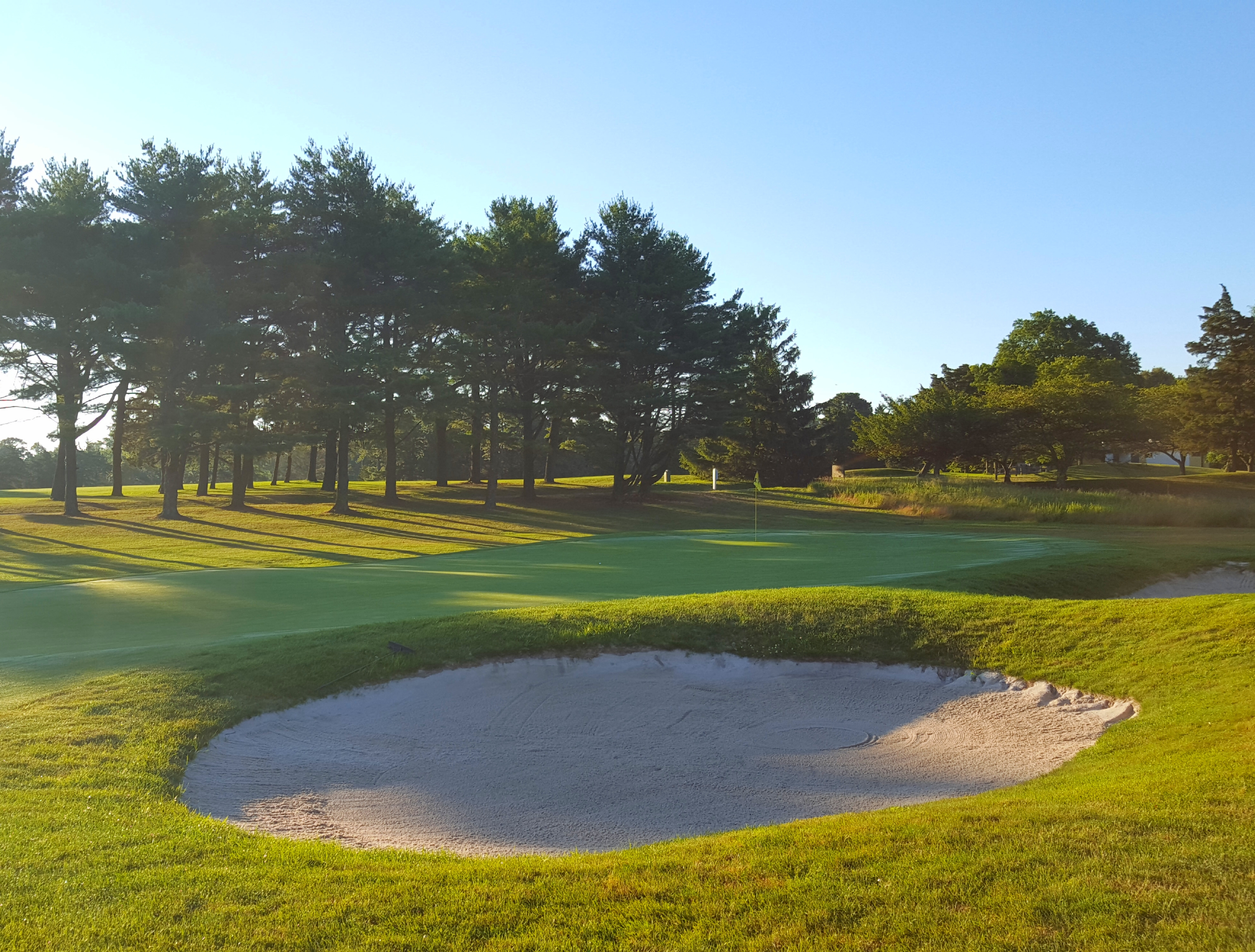
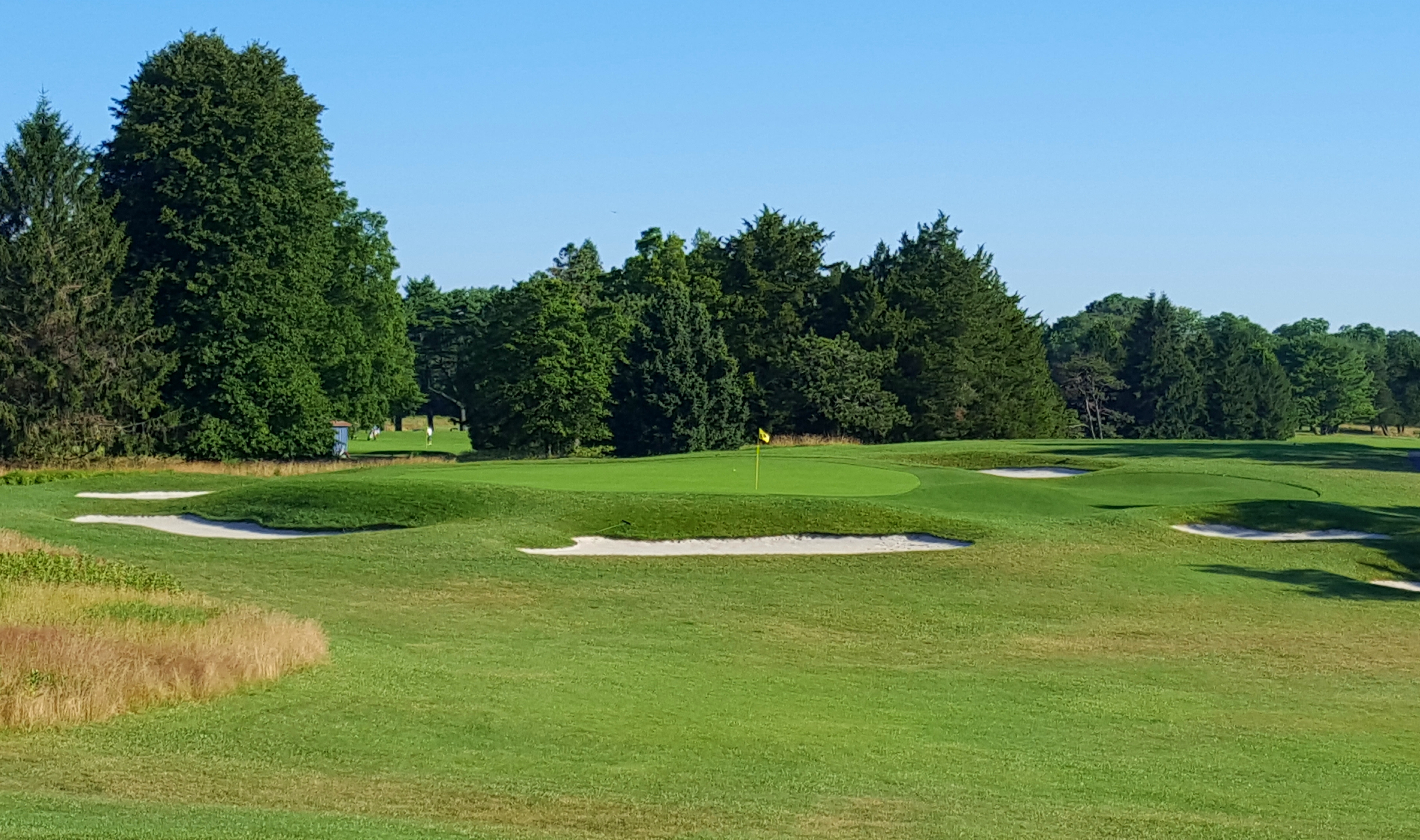
Loved these bunkers on 9
Overall, I enjoyed my time at Colonial Terrace. For $13 to walk nine holes on a weekday, it’s tough to find a better place to practice. It’s about a mile from Asbury Park and would make for a great casual round on a beach weekend.
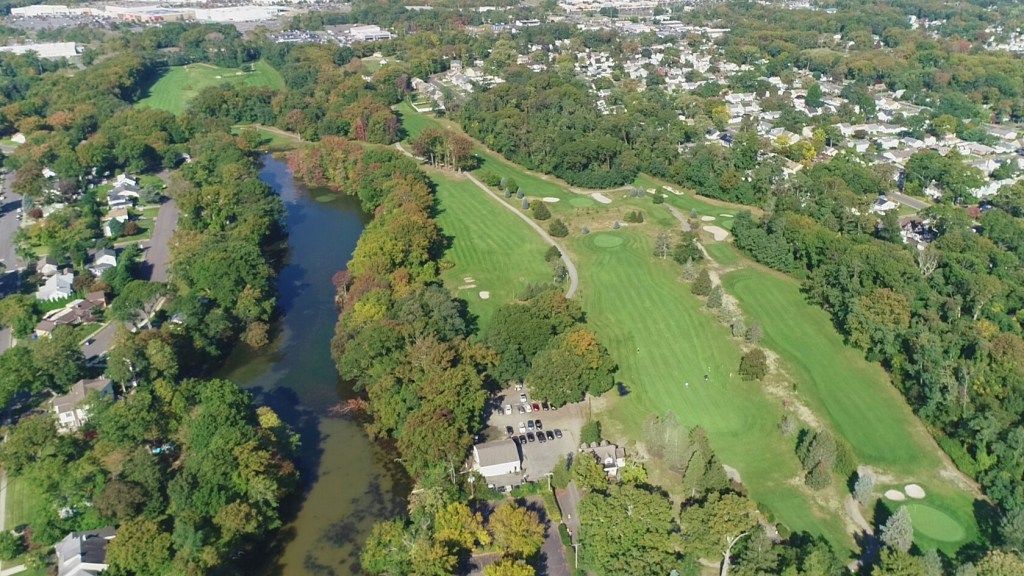
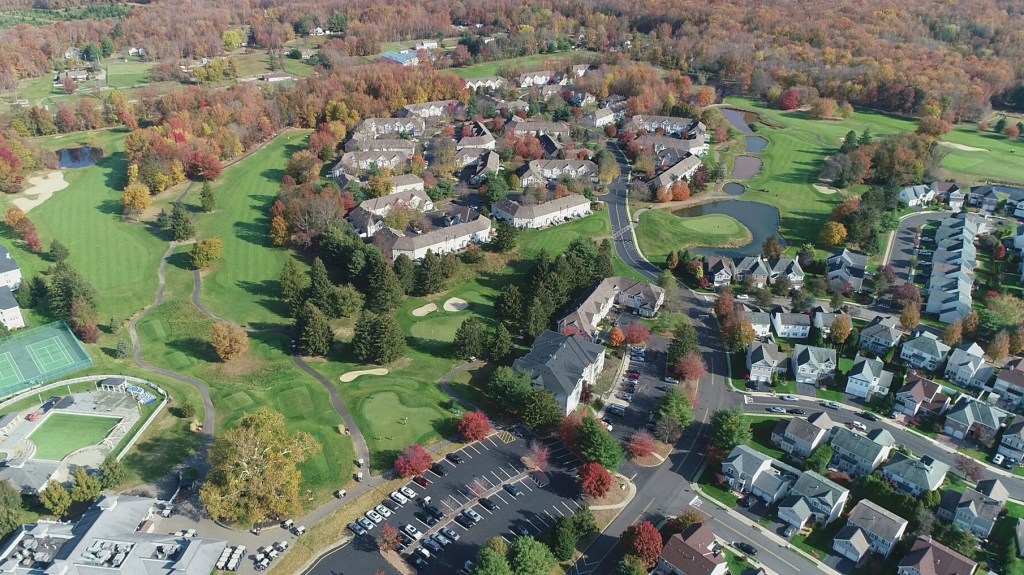
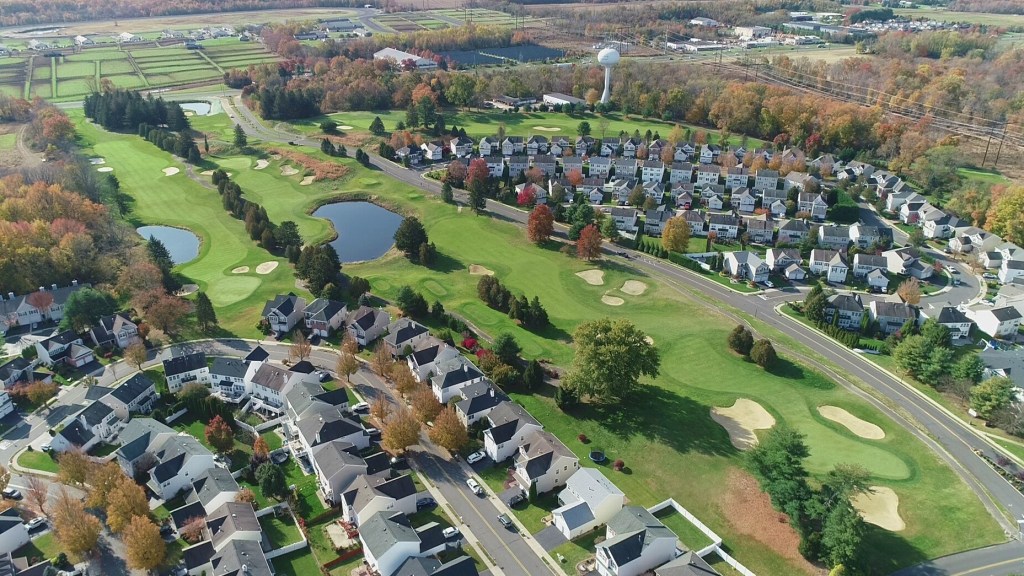
Colonial Terrace from above. The 4th hole is in the upper-left corner, its green being the furthest point from the clubhouse on the property. The 7th is in the top third at the center of the frame, coming back towards the bottom-right corner, where you can see the 9th green.
As the summer closed out in 2021, my good friend Ed and I took a look at our schedules to see when we could meet up to play some golf. Everything lined up for us to get out on the Saturday of Labor Day weekend. We chose Pebble Creek, a Monmouth County course I still hadn’t gotten to.
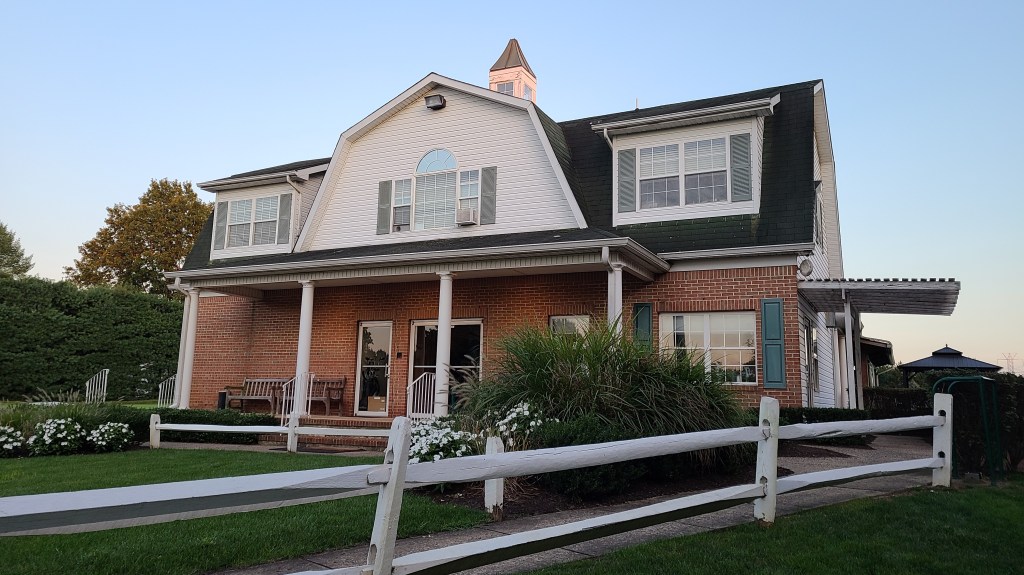
Nice little clubhouse and pro shop. Dutch farmhouse style? I don’t know. I’m a golfer, not an architect.
As I waited for Ed to arrive, I spent time chipping and putting at the practice green. Ed had a long drive and was set to get to the course just in time, so I moved all my stuff onto the cart and queued up. When I saw his car pull in, I drove out to the parking lot and helped him get his bag set up so we could get back to the first tee as soon as possible. Thankfully, we made it without issue.
We teed off at the first, and after I hit a sweet little pull-hook, we were off. Once I played my recovery shot, we both hit our final approaches and made our way to the green. As I stood over my ball to putt, I noticed that something looked off.
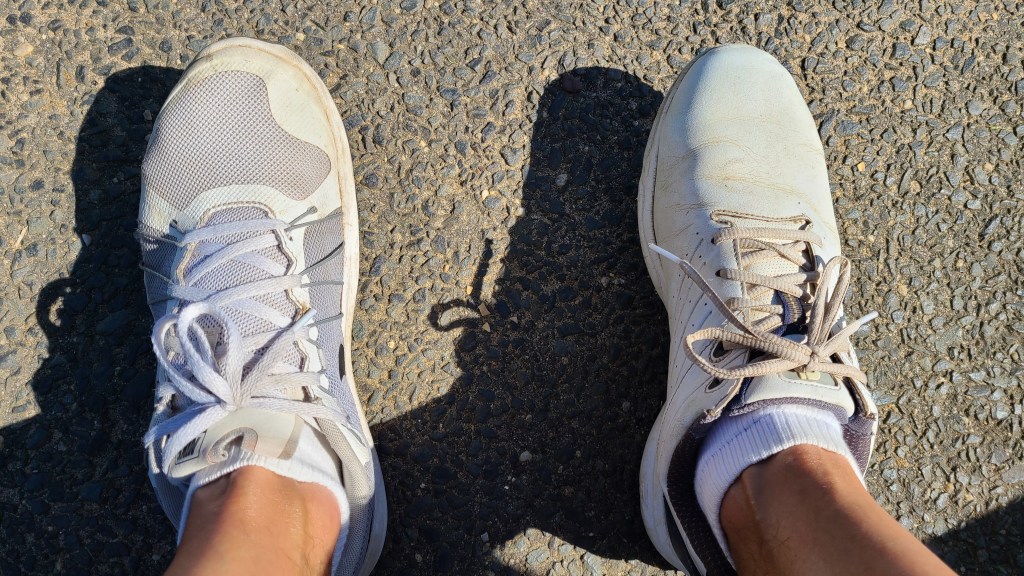
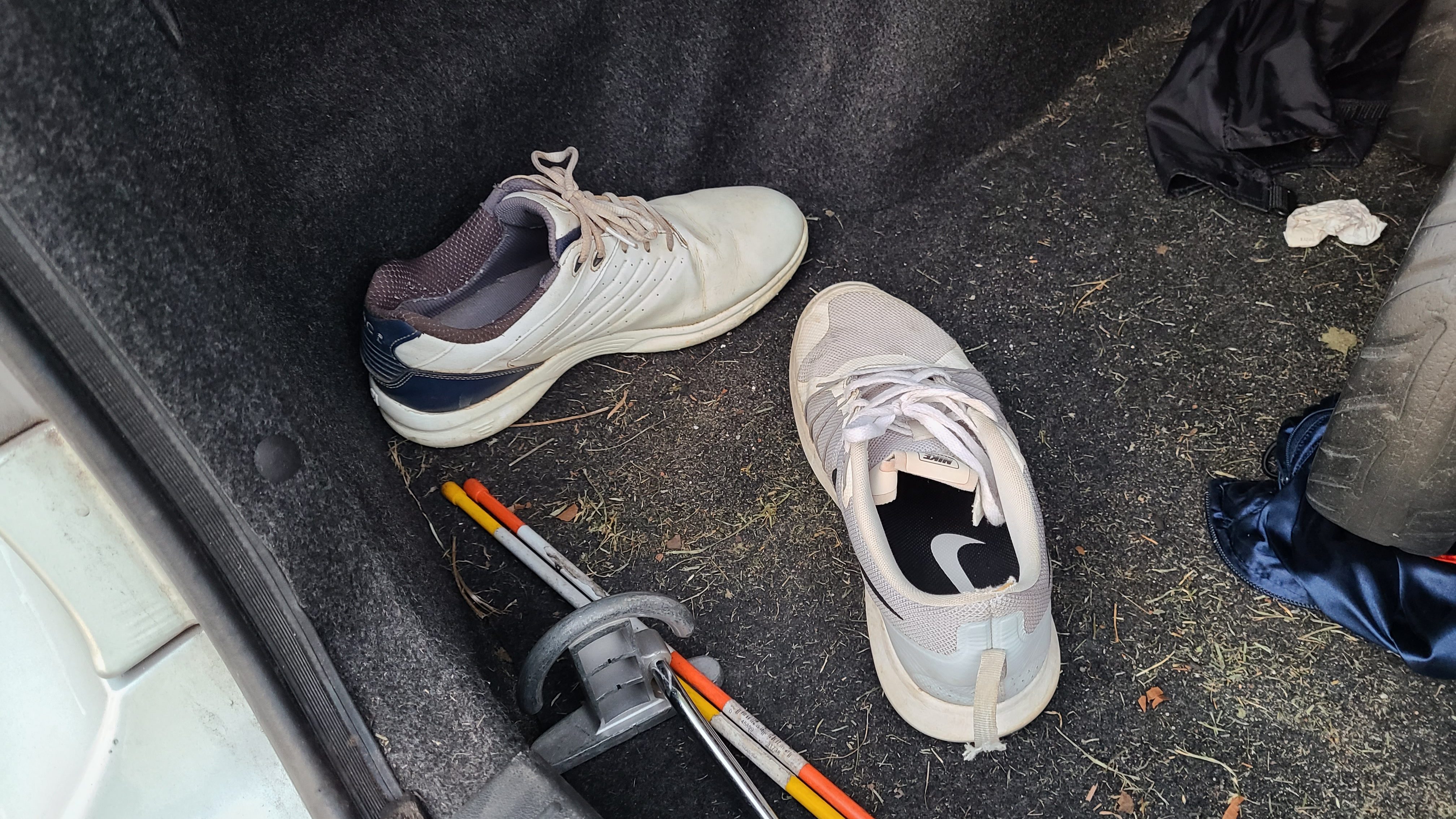
I was only wearing one golf shoe. On my right foot. My left foot still had my sneaker on it. We laughed about it and I rolled my 15-footer to save par. “I might wear one golf shoe all the time!” I joked.
Yep.
As we continued the round, I was impressed by the value the course offered for the cost. It was $55 to ride for a weekend round. In retrospect, I’m not sure if September marked the end of peak summer pricing for the course, but that is incredible value relative to other public courses in New Jersey. The condition of the greens, in particular, was fantastic at that price point.
Case in point: Fantastic green.
There are a number of memorable holes as well. 7 is a fun, drivable par 4 with a small but wonderfully shaped green. It’s guarded by a few small bunkers, though they’re relatively tame. 14 is a tough par 5, that starts to narrow out as the water encroaches onto the target landing area ahead of you. If you happen to hit a drive past this point, you can take a dangerous diagonal route over the water to reach the green in two. And 16 is another drivable par 4, albeit a 90-degree dog-leg right that would require an almost all-carry-over-water tee shot to get there.
The green at 7.
While not my favorite way to finish, Pebble Creek closes out on a par 3. Not sure what it is about par-3 closers, but it almost feels like an unresolved melody. My feelings about them aside, much like most of the rest of the course, 18 is another quality hole.
Again, I was very impressed by what this Monmouth County course had to offer. I’d probably stop short of a phrase like “hidden gem”, but it’s absolutely a strong competitor in a list of value courses. Definitely worth it if you’re in the area, and it wouldn’t be a bad course to travel to if you’re looking to mix it up.
P.S. BIG shout-out to the group that held onto my 4-iron after I left it at 7. Much appreciated!
14 green. That dangerous line I was talking about would be coming in from the lower right corner of the photo.Gorgeous, wide green at 15.Looking back at 16 in the fading light. You can just about see the water on the left side of the picture, center of the frame.Pretty sure I snapped this only after we drove back to look for my 4-iron.The par-3 18th.My left golf shoe… right where I left it.
My friend Matt and I wanted to get a round of golf in before an outing on Good Friday. We decided to take the Monday of that week off from work and head to Monmouth County to play Knob Hill.
A semi-private course situated on the westbound side of Route 33 in Manalapan, Knob Hill actually teases travelers with a peek at its 15th hole, which has its green placed just a partial wedge shot from the road. The course is a wonderful option for the golfing public, and I’ll try to cover some of its memorable features in a bit. But the story of my time at Knob Hill is really about its 7th hole.
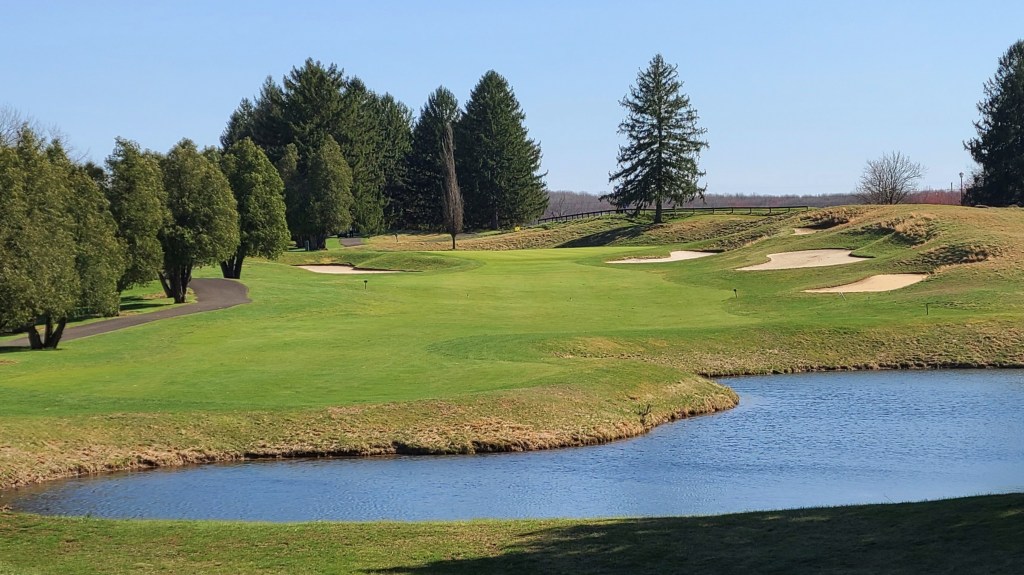
It is a straightaway par 5 that plays with a good deal of width for about 300 yards. A good drive put me in the fairway and about 175 yards from the green with the wind blowing in and across a bit. I took a 5-iron for some extra club, and though the ball started on a good line left of the flag, it seemed to quickly fail in the wind. I honestly thought it would die short in the water.
Nevertheless, it carried, landed, and stopped safely on the lower tier on the front right side of the green. I was on in two.
The pre-eagle has landed.
Having never made an eagle before, I really wanted this putt to sink. At the same time, it was such a difficult putt that part of me just wanted to park it close for a birdie. I notoriously leave lag putts short, and at just over 30 feet, I was psychologically in lag putt territory. I didn’t want to be struggling for a three-putt par.
I was left with a 33-foot putt that moved right to left, with probably five feet of break. It was also a couple feet uphill. I had a putt on a preceding hole the rolled out almost 40 feet on a much more level green. Given the uphill lie, I decided that same putting stroke should be just about right for 33 feet on this green. With my speed decision made, I took a couple looks at the break again, put my head down over the ball and made as good of a putting stroke as I could to at least ensure that I started it on the line I saw.
The ball made its way onto the upper tier, and started banking left quickly. I started to doubt my line and speed, worried that it would miss on the low side. But about five feet from the hole, it seemed to maintain its pace and definitely had a chance. I shouted “go in!”
It went in! The ball rolled in perfectly! After 20 years of playing golf, I finally had my first eagle!
Elated, we moved on to the 8th hole, where I immediately gave those strokes back. I struggled with the water-surrounded green, and would make double bogey. That’s golf.
From left to right: 10, 1, 9, 8, 7, 6
As its name implies, Knob Hill plays with a good deal of elevation change on a number of holes. The clubhouse is the highest point on the course, and whether you start your round on 1 or 10, your tee shots into either of these par-4 dog-legs will play to a pretty severe drop.
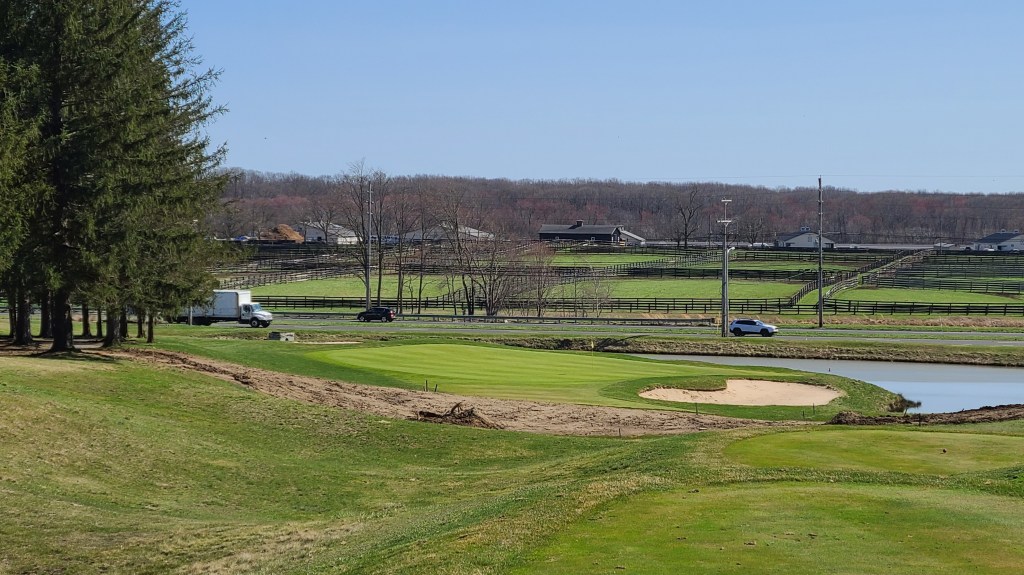
15, under some repair at the time. Route 33 in the distance beyond the green.
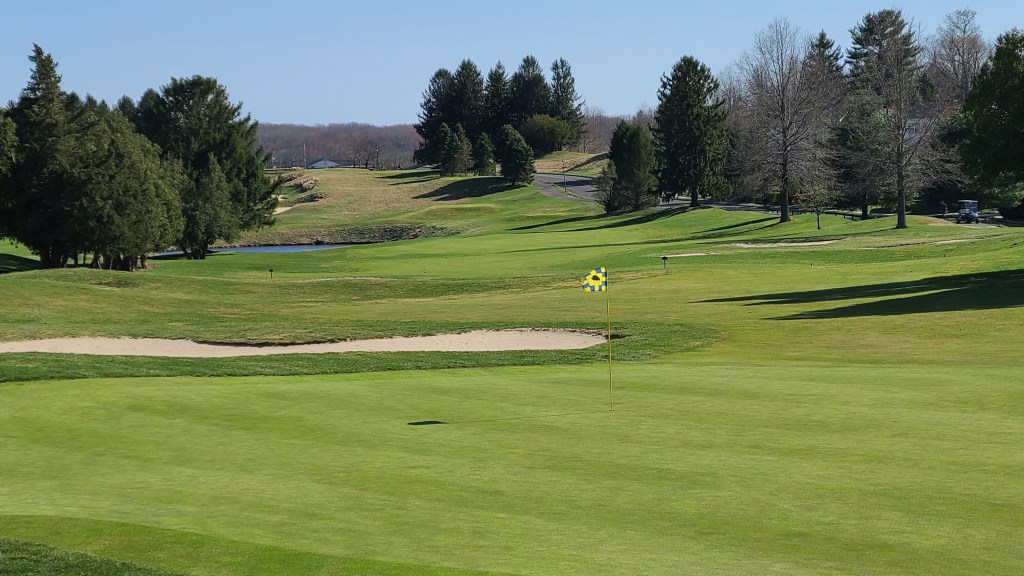
Other downhill holes include 15 and 17. The 15th is a downhill par 3 where over-clubbing coupled with a tailwind might put your tee shot into the passenger seat of a passing car. The 17th is a picturesque, drivable par 4, playing with some width, unless you choose to drive the green.
The 17th green is inviting.
The 12th is a very short par 3 – only 125 yards from the back tees – but plays about 20 feet uphill. Also playing uphill is Knob Hill’s closing hole. Though it tees off from elevated boxes, the 18th plays into a valley and back up the hill towards the clubhouse.
I would leave the undulating terrain of Knob Hill with a couple notches in my golf belt – another course played on my journey, and my first eagle.
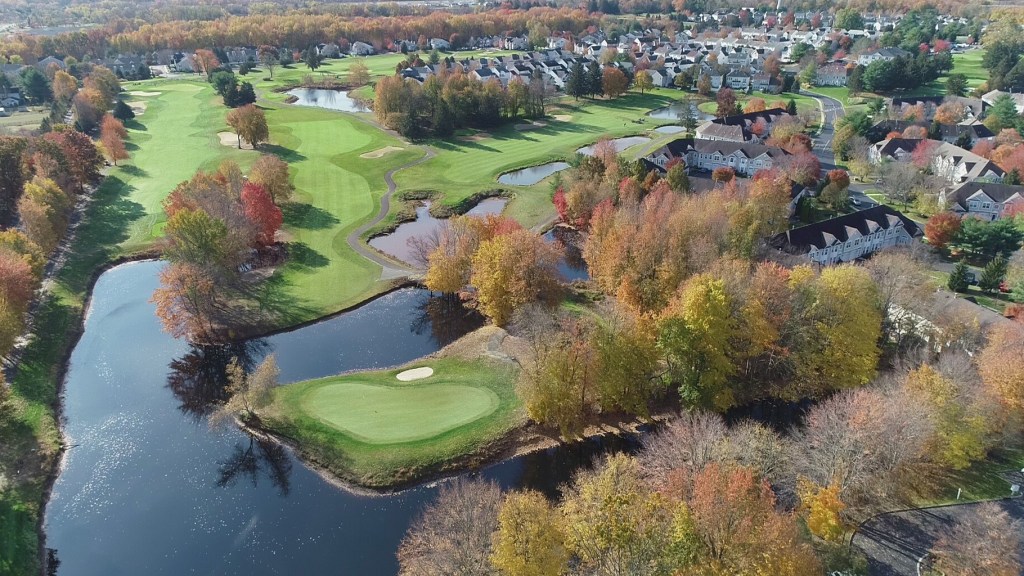
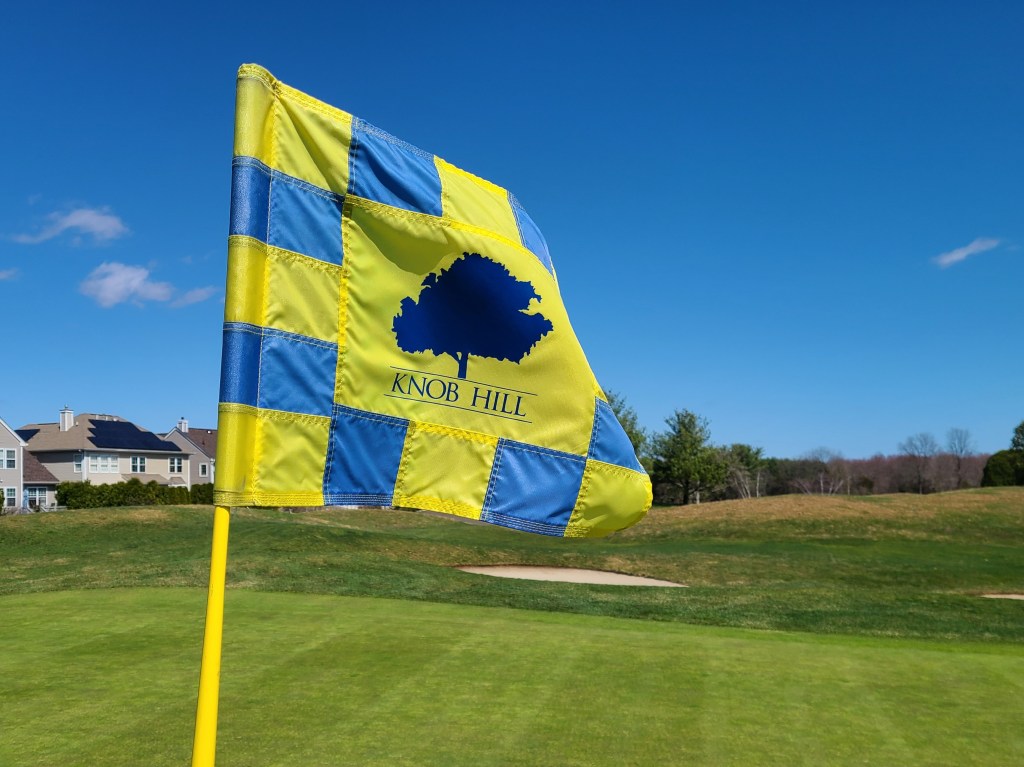
Looking back from behind 18 green.The 7th green, perilously surrounded by water. Short, right, and long are all dead.Bright and bold flags at Knob Hill.A great closing stretch of holes. Coming in from the top right, the par-5 14th moves left toward the entrance road.On the left side of the frame in the distance is 15, with 16 being the left-most, coming back to the horizontal centerline of the photo. 17 turns back the other way, and then 18 returns to the bottom-right corner.
A month after playing the South course at Charleston Springs, I met up with Walt again at Shark River. Located out in Neptune, the course is a couple miles from the ocean on the eastern edge of Monmouth County. Walt set us up with an early tee time, so I knew the drive would mean an early alarm, but I didn’t think anything of it.
Some people shy away from early morning tee times, but I have no trouble setting an alarm for 4:00 am and making a 2+ hour drive to make the first tee time of the day (like I did at Cape May National). I’ve played 5:30 am and 6:00 am rounds before a day at work. While it’s gotten difficult as I’ve gotten older, I enjoy being out with the dew-sweepers and still having the day ahead of me after a round of golf. So, when it comes to being on time for a round, I’m pretty reliably at the course before I need to be.
At Shark River, I was anything but on time for our 6:18 am. I would arrive at the course pretty much right at our tee time. I rushed to get the clubs and push cart out of the trunk as fast as I could. I threw on my shoes, and basically ran to the first tee. By the time I got there, everyone else in the group had teed off. I quickly got my driver, ball, and tee out of the bag.
I meant that quite literally.
This was as cold as you could be for the opening tee shot of a round. Nevertheless, not wanting to hold everyone up, I teed the ball up and swung. Somehow, the golf gods spared me embarrassment, and sent a low-flighted ball off the face of my driver and onto the fairway. Most of the round went generally smoothly as well.
Shark River would be my 12th public course played in Monmouth County, which has the most of any county with 19 total. The course is another example of quality golf in the area. I’ve often thought about which county should be deemed to have the best public golf courses, and while I have yet to submit a vote, I can tell you that Monmouth is definitely in the running.
Here are a few shots from our early morning round.
It took almost four years, but after playing the North course at Charleston Springs in November 2016, I finally made it back to play the South course. I was invited back by my Twitter golf buddy Walt Blasich who is quickly becoming my tour guide for the best public courses in Monmouth County!
Conditions were beautiful at the North, and the South is no departure. Both layouts are some of the most finely maintained public courses you’ll find in the state. You immediately get a sense of that as you walk off the back steps from the pro shop and look onto the flawless (and massive) putting green.
The putting green is big enough to accommodate all golfers waiting to tee off on both courses
If you love a good golf bridge, you’ll cross one on the long walk to the first tee, a great way opportunity to get your mind in the right place before the round. A short uphill walk through the woods after the bridge, and golfers are emptied out into the clearing that is the South course. Where the North is laid out in links style, forcing golfers to contend with many fescue-lined holes, the South is a sprawling parkland course. Although there are trees to deal with, the fairways are quite generous and there are a number of very open holes.
A walk across the bridge on the way to the 1st tee on the South course
From a design standpoint, the way the 6,377 yards (from the Gold tees) are spread across the 18 holes is done really well. The par 3s play as long as 195, but also as short as 115 on the 11th, something most courses shy away from. Of the twelve par 4s, there are four that play over 400 yards, but then there are also a couple that are drivable for long hitters, like the 294-yd 10th. You might be able to lodge a complaint about the par 5s as three of them are between 499 and 505 yards. But whether it’s differences in the way elevation or direction changes from tee to green, they are each truly unique.
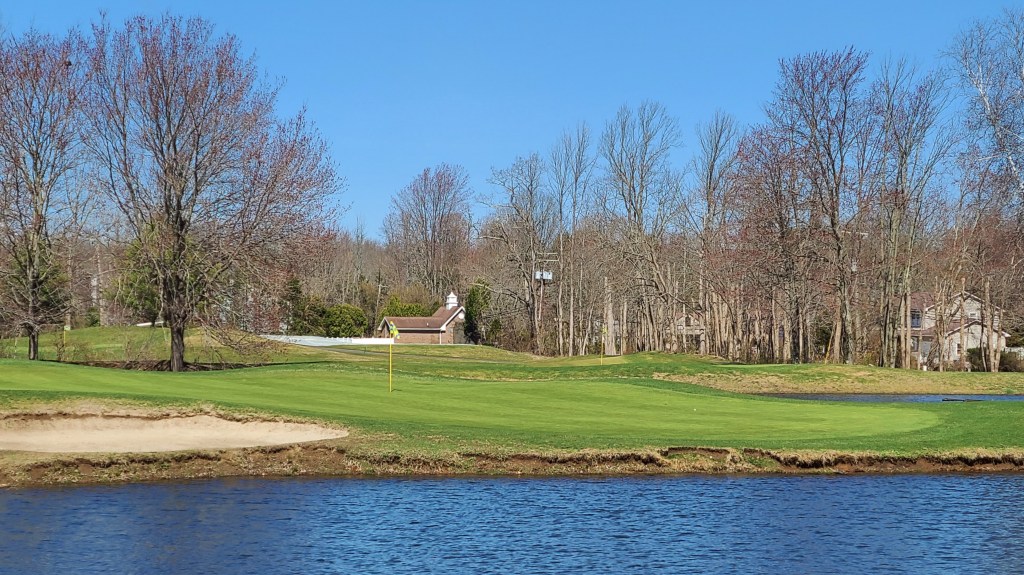
A front pin location on the 11th, with the drivable, par-4 10th in the background
As I mentioned when writing about my time at the North course, Charleston Springs is definitely held in high regard. I don’t know that the South measures up to public resort-type courses (e.g. Ballyowen and Crystal Springs), but I think it would be unfair to put either of the two layouts in that category. Nonetheless, it certainly ranks highly in the very next tier and should be considered a great option for public golfers.
Some golf courses have stories. Almost any course that has hosted a professional tour event likely has at least one great tournament moment. At the very least, they have the fact they’ve been a tournament host. Older courses have their history. Other courses are known for being designed by renowned architects.
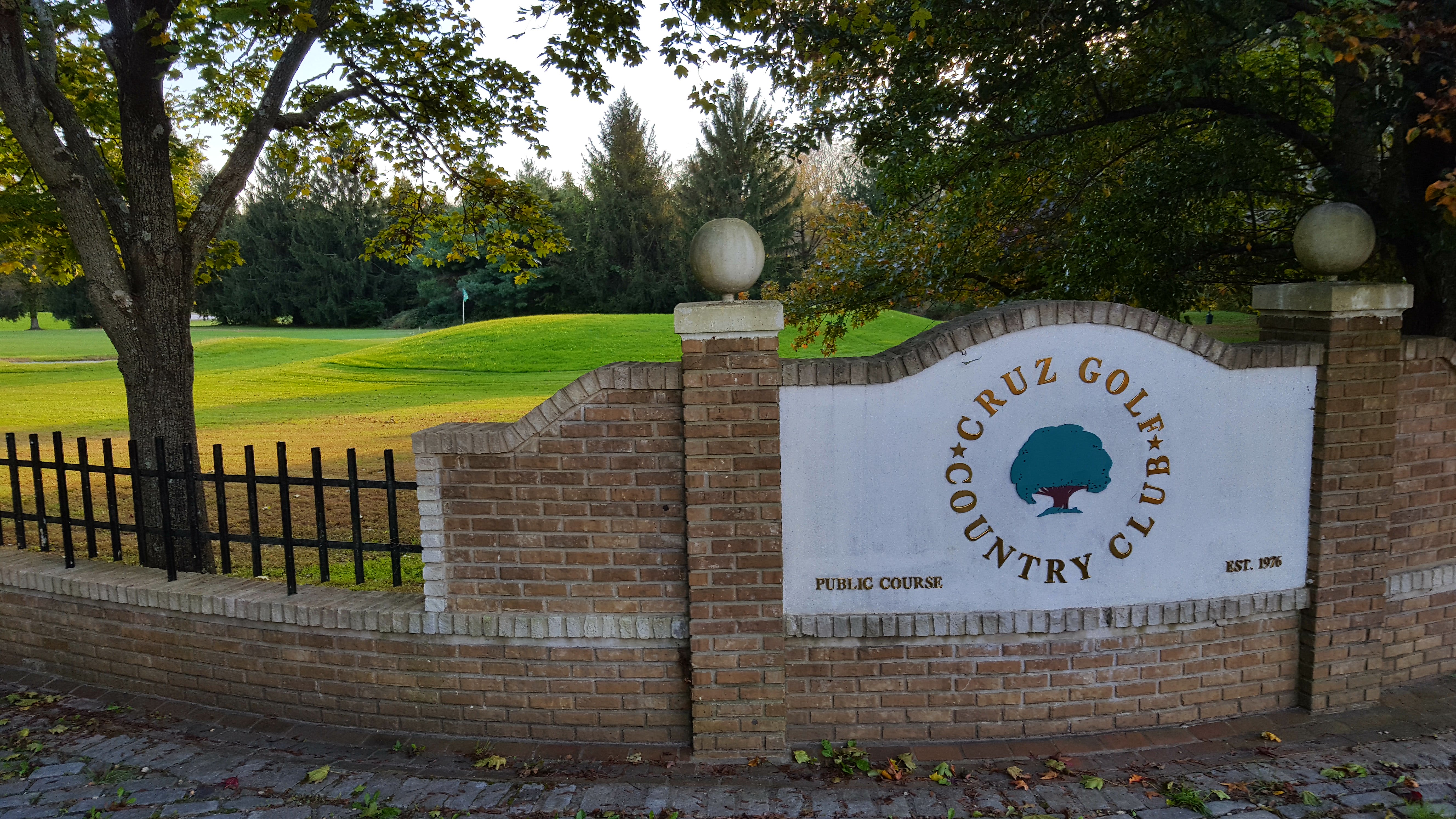
Accessible publics, on the other hand, are mostly just the storiless courses that people in the area happen to play. They’re the courses whose greens fees might be discounted with a county card. Number 80 on my journey to play all publics in NJ is different. Cruz Golf Country Club definitely has a story: the course was built by Evaristo Cruz.
If you’re wondering why you haven’t heard of this particular architect, it’s because he’s not one. Cruz emigrated from his native Portugal in 1946 and was not in golf course design by trade. He started a successful public works construction company in the early 1950s. Then, in 1976, with the help of his construction crew, he designed and built nine holes of golf on some of his own farm land. After adding an additional nine holes in the 1980s and opening it up to the public, it would eventually become Cruz Golf Country Club.
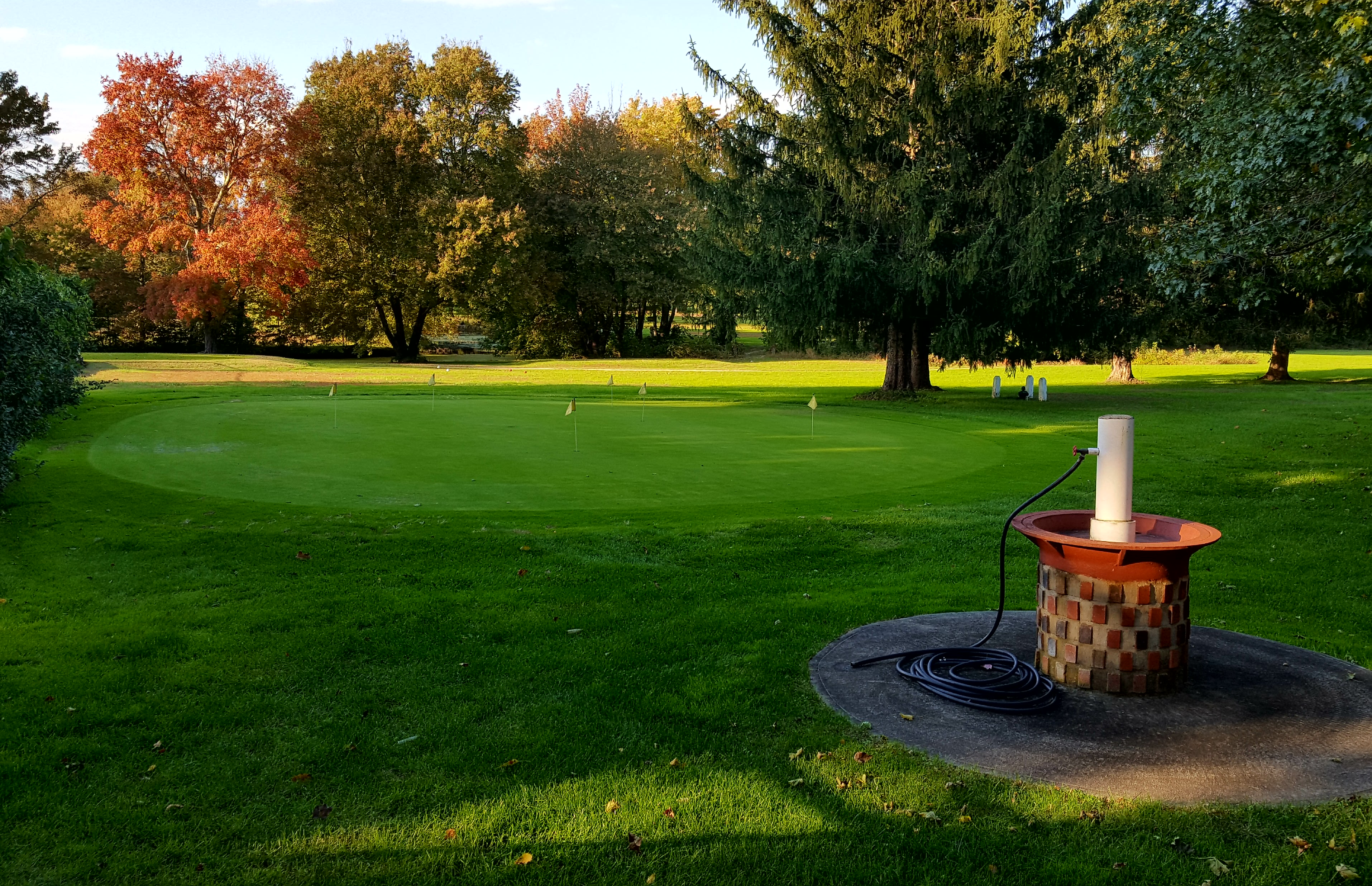
Cruz’s craftsmanship can be seen in a few places around the clubhouse, like this water source near the practice green
One of the shorter 18-hole courses in NJ, Cruz plays at just over 5,000 yards from the back tees. While it may be deficient in distance, it has a number of quirky holes. The 4th is a short, 286-yard par 4 that would normally be drivable, if not for the 90-degree dog-leg around the surrounding woods to the right. Holes 6 and 13 have prominent trees in or hanging over the fairway, making tee shot decisions important. The 16th is a short par 3 whose front edge is only a pace-and-a-half from the water hazard before it.
Fall colors starting to come in on 13
The course may not be anything special to a design aficionado, and its conditions generally won’t impress a seasoned golfer who has a number of gem-course notches on their belt. But, with its “no tee times” setup and only $26 to walk, I think it is more than deserving of a place in public golf.
There is a lot to be said about loving a game so much that you’d build a place to play it. It deeply resonates with the childlike spirit in each of us. It’s one thing to appropriate couch cushions and pillows for a “fort”, or to fashion a makeshift basketball hoop. Perhaps beyond that, one might build an actual tree house. But it is some serious love that would drive one to build a golf course.
I’m thankful that Evaristo Cruz had such a love for the game, and I believe I share that passion. Maybe I might build a golf hole or three in the future.
How I played…
Not bad, but at par 70 with a course rating of 64.3 and a slope of 114, this is a course where everyone should look to shoot a personal best relative to par.
Highlights: Once again, it would be enjoying the round with good company. It was a colleague from work that actually told me about the place, so it was good to finally get out there with them.
Lowlights: Nothing awful. Perhaps just not really capitalizing on scoring opportunities.
Howell Park Golf Course became the sixth track I’ve played in Monmouth County when a Twitter golf buddy (shout out to @njcroatian) invited me out for a round on Independence Day. Located just east of the Manasquan Reservoir, the course is wonderfully maintained and is part of the Monmouth County system, which at this point in my journey is arguably the best in the state in terms of access for quality.
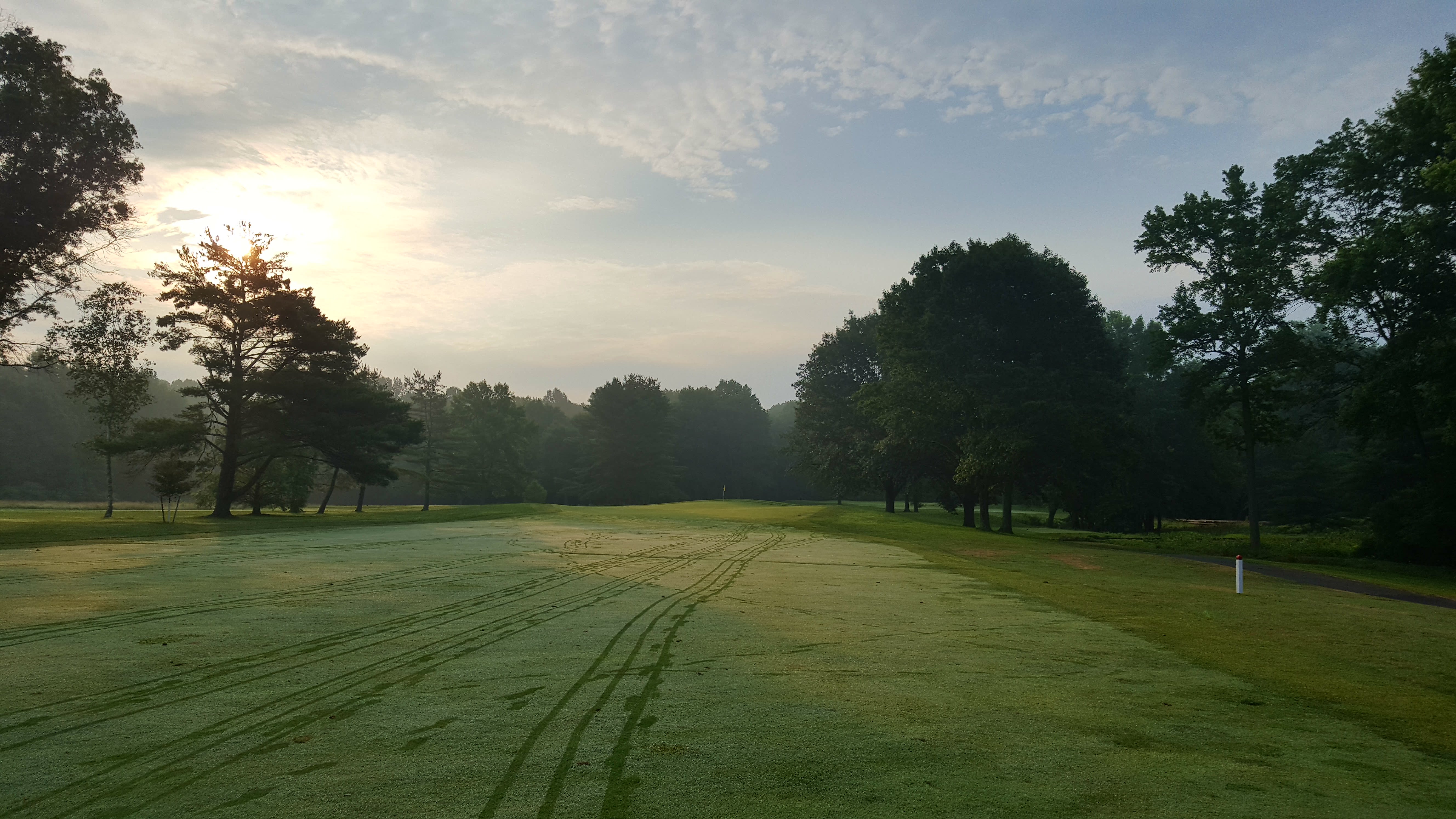
Quality dew tracks on the 1st
A parkland-style course that is known for keeping its rough up a bit, Howell Park rewards smart play that consists mostly of keeping the ball in front of you. The greens are some of the largest in public golf in New Jersey, averaging 34 paces in depth and some wider than they are deep. If you give yourself shots at the green and you putt well, this should be a course where you can score.
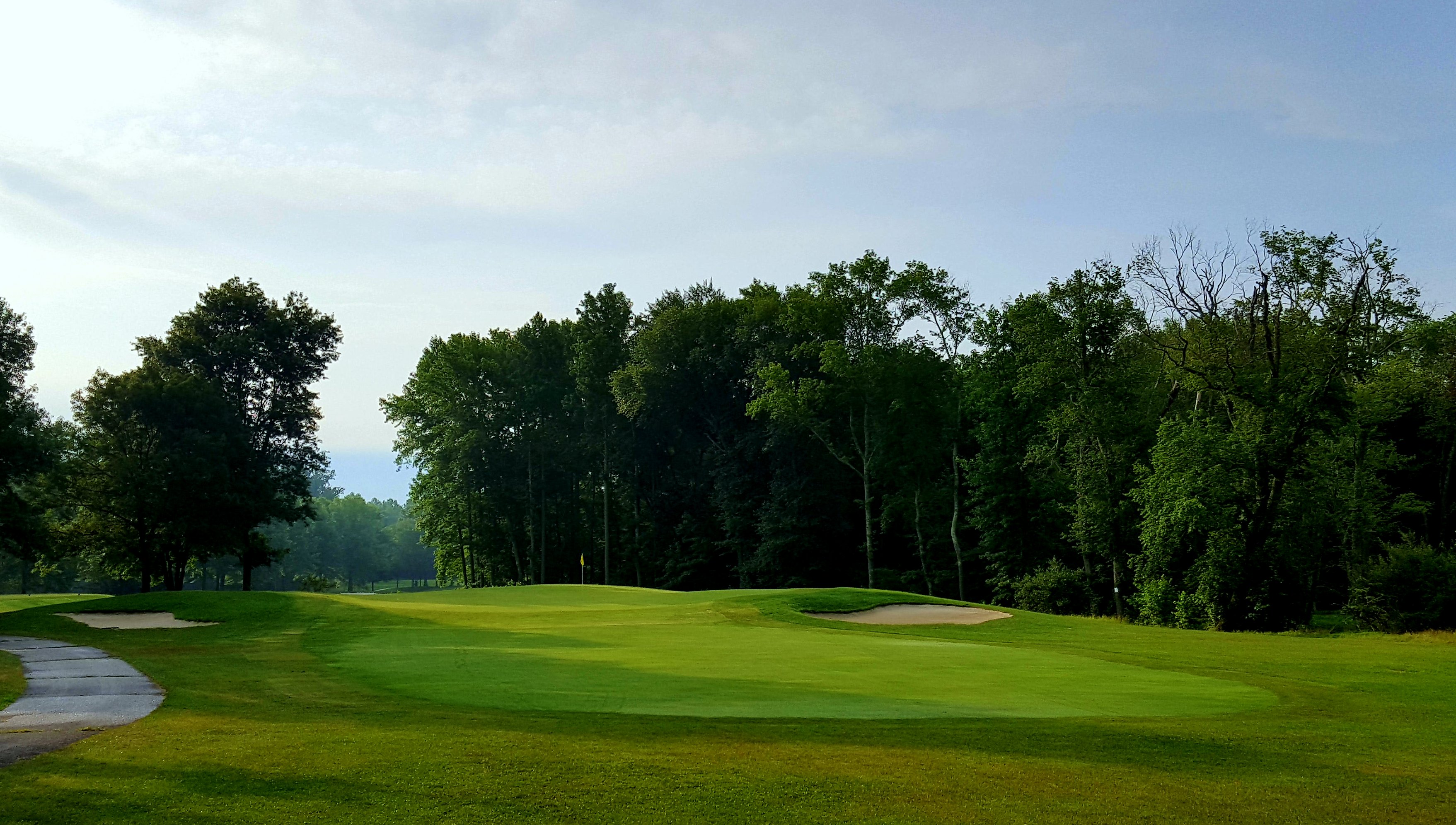
The green at the par-3 4th
The only complaint from an architectural standpoint is that Howell Park sits on a very level tract of land, so it lacks the views that come with elevation. However, its flat nature also means that it is a very walkable course. At $62 to walk on weekends for non-residents/non-cardholders, there is certainly cheaper public golf in the state. Regardless, I consider it a top-notch course and absolutely worth a round (or three).
How I played…
Hot and cold: Somehow, with penalty strokes on four different holes, I almost played down to my handicap.
Highlights: The singular highlight is easily the 18th. After watching my playing partner drain a 65-foot par save from the fringe, I followed up with a very lucky 54-footer for birdie. I think it rerouted twice on its way to the hole.
Lowlights: Penalty strokes; especially a ridiculous attempt on the 10th to “cut” one into the dog-leg that ended up OB on the driving range.





 Orson Rosas Golf