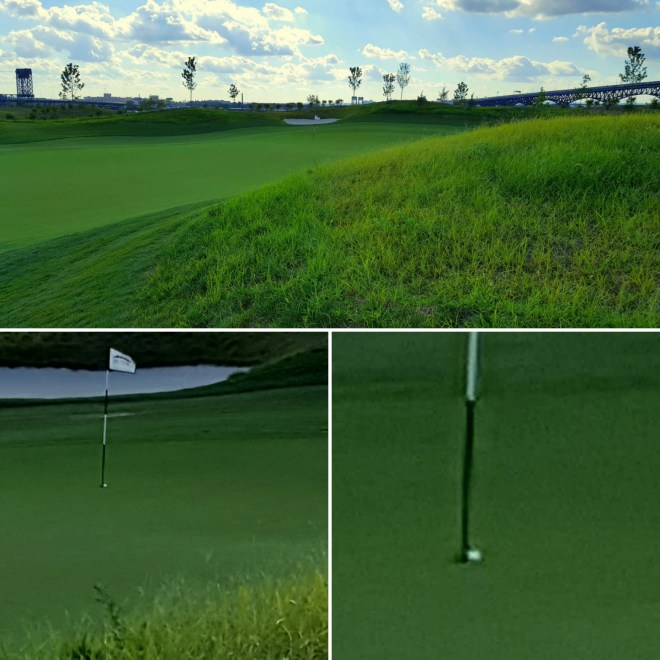
Number 52 (Neshanic Valley – The Ridge)

The 52nd course on my journey is at a facility that holds a special place in my golfing heart. It’s not somewhere I’ve played often, but Neshanic Valley was the first public course that blew me away.

Set just north of the Sourland Mountains in Somerset County, the Neshanic Valley Golf Course is a striking view from the main road to the course. As its name implies, turning into the course takes you down into and then back up out of a valley, where the clubhouse is perched at the highest point on the course. Driving through this miniature valley, you get to see about half the course layouts sprawling out to your left, and the driving range and Learning Center (also a Callaway Golf Performance Center) on your right.

The course comprises three championship, par-36 nine-hole layouts, as well as a shorter par-32 nine-hole Academy Course. Of the championship nines, I had already played the Meadow and Lake combination twice, so I needed to play the Ridge course for Number 52. The Ridge – named because it plays along the ridge that the clubhouse sits on, above the miniature valley – plays the shortest of the three nines, but only by a matter of the shortest of approach shots (3,516 yards to the Meadow and Lake’s 3,520 and 3,549 respectively). The Blue tees I played from measured at 3,106 yards. (The courses run by the Somerset County Park Commission don’t have White tees, and the Blues are comparable.)

Playing in late November, the weather was unusually warm. With the high temperature reaching about 65 degrees, as my playing partner put it, it felt like we were “stealing a round” from Mother Nature. But, as unseasonable weather usually goes, it meant a relatively windy round, particularly for the morning start we had.

I started the round bogey-bogey, which was alright for the 1st hole, but disappointing on the 2nd. A beautiful, short, dog-leg-left par 4, I managed to hit a decent draw to carry the corner, guarded by a menacing plot of fescue. I made poor work of the 59-yard approach, and ended up 42 feet from the pin. One of the characteristics that make Neshanic Valley an amazing public course is the speed of the greens. They roll as fast as any public I’ve played, probably between 10 and 12 on the stimp on any given day. Unfortunately, fast greens terrify me, and I three-putted for bogey.

The 3rd hole plays uphill the entire way. With the wind at my back, I hit a great drive a bit left, into a fairway bunker. From 142 yards, I managed to put the ball on the green, 15 feet past the pin. My birdie putt lipped out, but I was able to make par coming back for a sand save. The 4th hole is a straightforward par 3, but you must be accurate off the tee. Most tee shots that hit the green will funnel towards the lower tier in the back right corner. I pushed my tee shot right and got back on for bogey.

If the Ridge has a signature hole, I’d say it’s the 5th. A par-5 with something of a split fairway, you would need to carry about 270-280 yards slightly uphill to land on the finishing approach section on the left, which is essentially on the ridge itself. Otherwise, you make the smart play down to the main section of the fairway on the right, which plays back down into the second valley beyond the ridge. A long drive and a great second shot put me in position to score, but a fat third shot meant I would make bogey again.

After a “textbook” bogey (i.e. miss the green, chip on, two-putt) on the par-3 6th, I struggled coming in on 7, 8, and 9. I pulled the drive on the 7th, but managed to punch back onto the fairway and scrambled for par. On the par-5 8th, I topped both my drive and second shot, but managed to get just short of the green, then get on, and then two-putt for bogey. I hit the fairway on the 9th, but thinned my approach and went over the green. I got back on and made bogey again. My two pars and bogey golf meant I finished +7 for the nine-hole round.

If you haven’t been, Neshanic Valley is an absolute must-play. Designed by Hurdzan and Fry – most recently famous for their work at 2017 US Open venue Erin Hills – Neshanic Valley is consistently rated among the top 10 public courses in New Jersey. As with Erin Hills, there is plenty of fescue, so the play can be challenging, but the views are gorgeous. Whether you play the Ridge, Meadow, or Lake, or even the Academy Course, it is some of the most well-designed and well-maintained acreage of golf available in New Jersey. The experience is one you won’t forget.
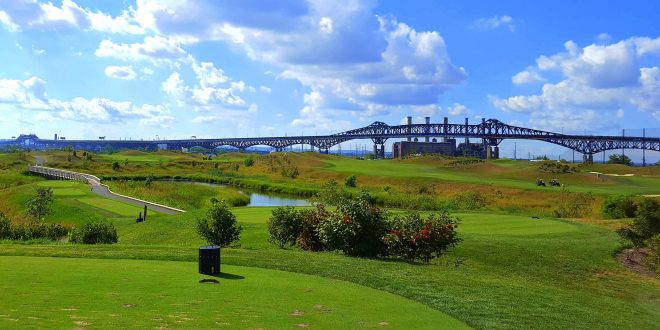
Number 52 (Neshanic Valley – The Ridge)

Number 51 (Charleston Springs – North)

Located in western Monmouth County, Charleston Springs Golf Course is a beautiful, sprawling facility. Comprised of two 18-hole courses, a driving range, and 5-acre Short Game Area, it was definitely one of the nicer courses I had seen to date. The two courses available are the links-style North course and the parkland-style South. The North is where I took my first swings at Charleston Springs for Number 51 on my journey.

Apart from seeing all the public courses on offer in New Jersey, the other great thing about my quest is meeting other golfers along the way. My ideal company for a round of golf is people who have fun, maintain a positive attitude, keep an honest score, and have an aversion to the word ‘mulligan’. My company on the day was just that. After waiting out a frost delay in the pro shop, we headed out to the putting green before finally being called out to the course. (Though, we almost missed our group being called, thanks to a muffled, low-volume PA system.) From there, a short, winding drive through the woods led us to the first tee.

I normally play from the white tees, or whatever would be considered their equivalent. On most of the New Jersey courses I’ve played thus far, there normally is an actual white tee box. When there’s not, anything between 5,800 to 6,300 yards will do. As a mid-handicapper, I’m not out to play from the back tees and have a bad time. I like the idea of having a consistent tee box choice, and having that tee box vary from course to course, each with its own variety of lengths, layouts, and challenges.

At Charleston Springs, we played from the ‘one-up’ tees, which was a method of choosing tee boxes that I hadn’t heard before. For those – like me – who didn’t know, this is a reference from the back tees; i.e. playing the next tee box up/forward from the back. I would’ve chosen the ‘two-ups’ – which were actually the 5,758-yard white tees – but I was outvoted, and happy to oblige.

Playing in the morning after a frost delay in early November, it was a windy and cold start. Nevertheless, I made a decent start through the first five holes, playing them in +3. The layout for the opening five is actually something I don’t think I’ve seen before, with the 1st and 2nd taking you away from the clubhouse, slowly turning tighter in a counter-clockwise spiral, culminating in the lakeside par-3 fifth, which also heads away from home.

As well as I had scored, I had been hitting poor shots from the fairway – both fat and thin – most of the round to that point. After bogeying the 6th, I lost a ball off the tee on 7 and had trouble getting out of a bunker on 8. I took double-bogey on both, but made par on 9 to make the turn at +8.

As the day started to warm, so did my game. After bogeying the 10th, I carded my first (and only) birdie on 11, and that began a 4-hole GIR streak. A shank off the tee and some poor iron play brought me back to earth with double-bogey on both 15 and 16. The penultimate hole is a semi-long, but wide open par 3 (at least from the ‘one-ups’). Headed back towards the woods that lead to the clubhouse, the closing hole is a departure from the design of the rest of the North course. Done in parkland style, the 18th has an incredibly tight tee shot around a large tree hanging over the right side of the fairway, and woods all along the left. I closed bogey/par, coming in at +6 for a round of +14.

While the facility is so much more than what I got to experience, I can say that the North Course at Charleston Springs is among the finer public golf you’ll see in New Jersey. Plenty of challenges, multiple tee-shot decisions, beautiful layout and flow, all on very well maintained grounds make this a public course worth checking out. I had heard this course referred to as ‘better than Neshanic Valley’, a course I hold in high esteem, both in beauty and experience. I don’t know if I would put Charleston Springs North quite there, but I can certainly see it being up for debate.

Number 51 (Charleston Springs – North)

Number 50 (Flanders Valley Blue)

Coming off the White after recovering my lost phone, I began the Blue (Number 50) at Flanders Valley with a quick change of shirt and hat, which I luckily had in my car. Thankfully, in addition to soaking my clothes and drowning my phone, the rain had also washed away any would-be golfers for the rest of the afternoon. My Good Samaritan playing partner and I were able to play on unimpeded. Some lighter rain would continue, but fortunately I was also able to grab my umbrella from my car.

We played out to the end of the peacock’s tail and back. I was able to hit five fairways and five GIR on the Blue, but my putting left much to be desired. I missed two 3-footers, and hit a poor lag on another to wind up with three 3-putts in nine holes. The highlight on the blue was the 6th hole, where – hitting both the fairway and green in regulation – I was able to card my second birdie of the day from five feet.

My new golf buddy was just along for the ride at this point, and after the 7th hole he took the cart back in as daylight was just about gone. I played out the 8th in twilight and finished the 9th in darkness. It cost me a ball on my approach, because while I struck it well, I had no idea how far it went. I dropped a ball, hit just short of the green, chipped on, and was able to two-putt for double-bogey to end my epic 36-hole adventure. Bogey golf on the White and +6 on the Blue meant I would finish +15 through 18 holes.

Last one off the course, and fifty courses completed on my journey.

Number 50 (Flanders Valley Blue)

Numbers 47 and 48 (Flanders Valley Gold and Flanders Valley Red)

My day at Flanders Valley was only the second time on my journey that I had played 36 holes in a day. Playing the Gold & Red with a good friend of mine, I had something of a tale-of-two-nines round.

The Gold (Number 47) is the hilliest of the nines, and playing it feels like you’re traversing the side of a mountain. Fairways are relatively narrow for the most part, and there is a decent amount of elevation change within holes, with a few semi-blind shots.

I had a miserable start to the day on the Gold. The first hole is a beautiful, uphill-all-the-way-to-the-green par 5. My drive and lay-up weren’t terrible, but from 102 yards, my third shot managed to come up short of the green by committing the amateur mistake of failing to account for the elevation. An awful chip placed me 28 feet beyond the hole – and above it – which I rolled down the hill, 26 feet PAST the hole.  I was able to lag this one a bit closer (2 feet) and holed out at double bogey.

Some more of the lowlights from the Gold were 4-putting the 2nd, losing a ball on both the 5th and 7th, and putting a total of 21 times, for a score of 49 (+13). Scared to death of the greens, I was now worried that I could possibly shoot over 100, something I hadn’t done in two years.

On the other side of the course premises, and something of the Gold’s opposite, The Red (Number 48) is the flattest of the nines. I wouldn’t describe it as a links layout, but its lack of elevation change and relative openness (at least for the first three holes) are definitely a stark contrast to what was experienced on the Gold. I played well here.

Coming off two pars on the Gold 8th and 9th, I was able to salvage an 18-hole score, continuing at even par by going bogey-birdie-par through the first three on the Red. A string of bogeys with a par on the par-5 6th meant I finished the Red in +5, for an 18-hole score of +18.

If you play Flanders Valley, I highly recommend playing the Gold & Red combination first. The contrast between the two nines makes for a nice experience. You essentially have to play two different types of golf to score well overall.

Playing in late October before Daylight Saving Time had ended meant there was still a decent amount of light left. I decided that I should try to get all four nines in by continuing onto the Blue & White. The weather looked questionable, but it was a long drive home, and I was already at the course. To seal the deal, they offered a great replay rate, and so I couldn’t refuse.

Numbers 47 and 48 (Flanders Valley Gold and Flanders Valley Red)

Number 49 (Flanders Valley White)

I parted ways with my good friend, Ed – who packed it in after the Gold & Red – walked onto the White (Number 49) with two other golfers, and I was on my way. Excited about 36 holes in a day, I took my phone out to snap a picture on the 1st fairway.

Whatever I had going for me on the Red, I couldn’t keep going on the White. Nothing was terrible, but errant tee shots had me working for bogeys, and I made double on the 1st and 4th. Bogeys followed on the 5th, 6th, and 7th. Having made par on the 2nd and I was hoping to at least finish the nine in “bogey golf”, so I needed at least one more.

The weather worsened and the sky absolutely opened up. Luckily, we were just coming off the 7th green, and there was a rain shelter before the 8th tee. As it poured all around us, I went to my bag to find my phone out to check the weather and tweet about my adventure.

No phone.

The main pocket zipper on my golf bag was open, and the phone was nowhere to be found. Between bouts of cursing myself out for being an absent-minded idiot, I tried to think of where it could be on the course while we waited for the rain to subside. Other than taking a picture on the 1st, I couldn’t think of any place else it could be.

Determined to finish the round, we saw an opening in the weather and decided to continue play. I would worry about the phone later. I would par the 8th and bogey the 9th. Bogey golf achieved. The White was finished in +9.

Running back into the clubhouse, I told the staff my missing phone plight and they let me take a cart out. One of my new playing partners even offered to help look, which I thought was incredible. With some good fortune, we were able to find it about 40 yards short of the 1st green, where I had pulled my approach shot. It was drenched and out of battery. Once again, I would need to worry about my phone later.

The Blue was calling me.

Number 49 (Flanders Valley White)

Numbers 47 through 50 (Flanders Valley Golf Course)

You may be thinking “how does a single course count as four?” I’ll try to explain.

Flanders Valley Golf Course, located n Flanders as its name suggests, was only my second Morris County course after Pinch Brook. It features four 9-hole layouts that fan out something like a peacock’s tail; Gold, Red, Blue, and White. The scorecards treat these as two courses.

The Gold & Red Course would be the outermost “feathers” on the tail. If positioned with your back to the clubhouse, looking out onto the courses, the Gold nine is laid out to the far right, and the Red nine is laid out to the far left. Flanked by the Gold & Red, the Blue & White course is the center of the peacock’s tail, with the 5th tee on the Blue nine being the absolute tip, furthest from the clubhouse.

Sounds like two courses.

Struggling how to count these on my list of public NJ courses for my journey, I kept looking for details in the scorecards. For the Gold & Red, the Red nine is listed as holes 10-18, even on the course map. The same goes for the White nine on the Blue & White.

The Gold & Red list a total yardage of 6,770 from the back tees, and the Blue & White also has a combined yardage, marked as 6,765 from the tips.

Still just two courses. But, then I noticed how they handicapped the holes:

Gold: 2, 8, 3, 1, 6, 7, 4, 5, 9

Red: 4, 5, 2, 6, 9, 3, 1, 8, 7

Hmmm…

Blue: 5, 1, 8, 2, 4, 7, 6, 9, 3

White: 3, 7, 8, 4, 5, 2, 9, 1, 6

Why handicap them separately if these were supposed to be two 18-hole courses?

It made me think of other courses in the state that are only nine holes (e.g. Skyway in Jersey City, Hudson County) as well as some 27-hole layouts (e.g. Neshanic Valley in Branchburg, Somerset County). In these set-ups, all nine-hole layouts are handicapped separately. For 27-hole layouts, even though you can play any combination (i.e. 1-2, 2-3, 3-1), you’ll find them handicapped as individual nine-hole tracks.

That makes Flanders Valley four distinct nine-hole layouts, and four courses on the list.

I’ll touch on some of the differences between the four nines in the following posts when I talk about my rounds, but overall Flanders Valley is a beautiful place. If you play all 36 in a day (as I did) you’ll experience a great variety of holes and be challenged with shot-making decisions. The greens roll exceptionally well for a public course – something I had trouble with – especially on the Gold. If I had to guess, I would say they roll about a foot farther/faster on the stimp than your average public in New Jersey.

Bonus GolfingNJ (and Footgolf) Fact: Flanders Valley also has the distinction on my journey as being the only course where I’ve played footgolf before I’ve played golf. The 18-hole footgolf course is laid out on the White nine.

Numbers 47 through 50 (Flanders Valley Golf Course)

Number 44 (Skyway Golf Course at Lincoln Park West)

20160818_162610

Date Played: 8/8/2016

Opened in June 2015, Skyway Golf Course in Jersey City is easily the youngest course I’ve played, and with its youth comes beauty. Having the distinction of being the only public golf course in Hudson County – a small county of almost entirely urban geography – Skyway is breathtaking.

I mentioned how East Orange Golf Course’s downtrodden reputation is juxtaposed against its affluent background, but Skyway is juxtaposition in its purest form. Newborn lush fairways and greens set against aging man-made materials: concrete, asphalt, and steel. The drive up to the diminutive parking lot is on an absolutely beaten and forgotten road, littered with potholes and lined with truck yards and industry to the right. It is the last road you’d imagine leading to a clubhouse. But once you’ve entered and walked onto the course, it is another world.

Being on the course feels like being inside a sci-fi dome. With countless dunes and rolling fairways, almost the entire nine-hole layout is elevated from the topography of the surrounding area. From the tee box on the third hole or from the 5th green, that road to the clubhouse seems like a dried-up asphalt river at the bottom of a valley off in the distance. You have incredible views in multiple directions, with the Manhattan skyline to one side, the remaining marshlands on the inlet from the Hackensack River on the other, and the Pulaski Skyway – for which the course is named – joining the two.

20160818_161728
The approach on the par-5 3rd, with the Freedom Tower in the background

Considering golf an 18-hole event, I was sort of resigned to the fact that I would only be playing nine holes. As I described, all of that resignation went out the window once I was on the course. I could have played three holes and been grateful to have been there.

Whether it was inspiration from the splendor of the course, or if it was just that I was “on”, I enjoyed a great round of nine holes. I carded nothing higher than bogey, and finished +5 on the day. It was hard-earned by scrambling most of the round. I only hit three of the nine greens in regulation, but my short game carried me. On the 5th, I hit a soft-landing sand wedge from 40 yards that ran eight feet to the pin and lipped out after going 450 degrees around the cup and stopping just an inch outside. On the 7th, I hit the pin once again and lipped 180 degrees around it, stopping at 2.5 feet. I finished with only 9.2 feet of putts made.

IMG_20181225_123312
My 3rd shot on the par-4 5th. How does that not go in?!

Having been in Jersey City for work for the day, there was definitely the excitement of playing a round of golf after a day at the office. But being on the first tee at Skyway was something beyond that. I experienced a deep appreciation for everything they accomplished in designing and building the course, and I felt like I was truly somewhere special, which is what golf courses should feel like.

The word “infant” comes from the Latin for “unable to speak” or “speechless”. If you are a golfer within 30 miles of Jersey City on the New Jersey side, you must play this infant course. Unable to speak for itself, it may just leave you speechless.

Number 44 (Skyway Golf Course at Lincoln Park West)

Number 38 (Pinch Brook) (… and numbers 39, 40, 41, 42, 43, and 44)

I told you that you’d be joining me in the middle of my story, and it has progressed without my updating you. So, I figured I’d at least catch you up to the present. Since my last post, I’ve played six new NJ public courses (new to me, that is). Those courses are:

Pinch Brook

The 38th course mentioned in my last post was Pinch Brook Golf Club (Florham Park, Morris County). The signature hole at Pinch Brook is the 16th, which is a medium-length par 3 from a slightly elevated tee. The hole plays over water and is a tough shot if you don’t hit your wedge or iron squarely. I hit six greens in regulation that day, and luckily this was one of them.

While the 16th may be the signature hole, I’d say the signature feature is actually the body of water between the 5th and 6th holes. The starter was kind enough to give us a quick overview of the course at the start of our round, and he mentioned that the water is actually in the shape of the state of New Jersey! Personally, it reminded me of my mission and I almost treated it as kismet for the day.

Unfortunately, kismet only took me so far, and I wasn’t able to really get anything going. I was grateful to be grouped with a couple who play the course often, but I failed to take advantage of their local knowledge. I fared poorly throughout the round, and finished up at +19. I’m finding that to be just about average for when I play a course for the first time, but with nine par 3s and par being 65, I left a bit disappointed in myself. Averaging 1.1 holes at triple bogey (or worse) per round for the year, I carded three this round.

Pinch Brook was the fifth course I’ve played in Morris County. Overall, the course is beautiful. It’s incredibly well maintained for an executive course, but the greens fees reflect that, costing as much as most regulation public courses in New Jersey. Price aside, it’s absolutely worth a look if you haven’t played it.

Number 38 (Pinch Brook) (… and numbers 39, 40, 41, 42, 43, and 44)

Golf: How far have you driven?

A number of things have happened since my last post:

  • I have played four more courses for the first time, bringing my total to 38 (20.5%).
  • The weather in New Jersey has gotten significantly warmer.
  • I have moved home base for my golfing operations… which is to say I’ve moved altogether.

Looking back on this quest and reflecting on my recent move, I realized this is the fourth location from which I’ve ventured to new golf courses. Raised in Bergen County, I moved to Middlesex County with my wife-to-be in 2006, then to Somerset County in 2009, and we now call Mercer County home. With all of the moves and different home bases in mind, and knowing that I still had a long way to go in terms of New Jersey courses left to play, I wanted to get a sense of how far I’ve already gone. How far have I actually driven to play these courses?

Gathering the data told me some noteworthy things about my golf timeline.

  • While I first picked up a set of golf clubs sometime in the late 1990s, I didn’t play a regulation-length course in New Jersey until 8/13/2005.
  • Between 2005 and 2010, I only played seven different NJ courses. That’s an average of about 259 days between each new course.
  • After a hiatus from 2010 to 2013, I’ve played 31 additional courses. That’s an average of about 36 days between each new course.
  • I found out about my golf quest on 10/15/2015. Since then, I have played 11 new courses, an average of about 18 days between each new course.
  • To date, the furthest I’ve driven to a golf course (one-way) is 63.3 miles.

Taking a look at each course already checked off my list and factoring in when I first played them and where I had lived at the time, I was able to calculate that I have driven a total of 1,942.4 miles (round trip). To put that in context, here are the distances to different golf landmarks across the country from my current location in NJ:

How far have you driven?

Golf: How far have you driven?

In Medias Res

The Latin phrase in medias res means “in/into the middle/midst of things”. That is how my story begins for you. When used as a literary technique, it’s sometimes meant to be in the middle of some critical plot action, like a battle in war. While I can’t say my story promises such action, you join it in the middle nonetheless.

In my first entry, I mentioned that I was excited about the idea of playing over 100 different golf courses in New Jersey. What I didn’t mention is that it’s also exciting because it means I will travel to areas of the state that I may not have otherwise visited, or even planned to visit. As a lifelong New Jersey resident, this was an endearing prospect. Prior to taking on this journey, the only time I got to new areas of the state in the last four years was on “nap drives”, trying to get my reluctant-to-nap daughters to fall asleep in the car. I used a lot of these drives to find new golf courses and wondered if I’d ever play them. Now I had a reason to.

One of the interesting things about this goal of playing all public courses in a state is that, by pure chance, I happened to be born in a state where this is actually probable, or at least achievable in a lifetime (while raising a family and working a full-time job). When I first considered it, I thought that – apart from other geographically small states like Rhode Island, Connecticut, or Delaware – there must not be many states where someone could take this on. States like California and Texas make the task unlikely with their geographic size and abundance of golf courses, but what about Alaska? It turns out Alaska only has eight regulation-length, 18-hole courses. That makes the 49th state possible, so what about the 50th state? Hawaii is probably likely as well, seeing as it’s only a few small islands. And if Alaska only has a few courses because of the cold climate, what about states that are mostly desert, like Nevada, Arizona, or New Mexico? I suppose as long as you’re willing to make the drives all over those larger states, they would make for accomplishable goals as well.

With the knowledge that “The Goldilocks Zone” for entirely playable states was larger than I initially thought, I focused again on my home state. New Jersey has 21 counties and – by my count – 350 golf courses, 185 of which are public. Coming by these numbers was more difficult than I thought it would be, and I’ve learned that between some courses closing and others being difficult to find, the number is definitely subject to change.

So, how far “in the middle of things” are we exactly? As of the time of writing, I have played 34 of the 185 public courses in New Jersey. That means we’re roughly 18% of the way through my journey. It also means that Kermit was off by a few courses (37, to be precise).

In Medias Res